Thursday, December 16, 2010

PCs & 63s - Part 6

There has been no shortage of amusement to be had with this PC stuff. Remember when you first saw those alarming messages, “fatal error, illegal operation, critical condition” flash onto your screen? Goodness gracious, I expected an imminent lighting strike or the cops charging in the door any moment.

Once businessmen broke the 40+ year grip engineers and programmers held over computer technology (since 1939 prox), the flood gates of innovation started opening as fast as technology advancements could be accomplished. Driven by demand identified by businessmen, the techs were funded and tasked to develop the necessary technologies to meet the demand. Engineers might find certain tasks scientifically impossible, but are very good at developing suitable alternatives.

When the Net started opening up to the masses about 1995, we the masses responded in many different ways. Our children quickly gravitated to “chat rooms” where they could readily meet perverts posing as peers. Parents had no clue...nor did teachers…nor did legislatures…nor did law enforcement. The only response we really had then was to keep ourselves informed, keep an eye on the kids and limit access to the net until we could figure out what was going on.

With the subsequent arrival of broadband about 2002-3, which enabled rapid transfer of images and videos, came more issues. Cell phone access to the net compounded those same issues even further. Now our pubescent offspring could recluse themselves and send out x-rated pictures to the world. Probably never before had competent parenting been more important or more lacking.

At work, adults had and still have similar problems with their junior employees. Not only is it a problem concerning competent business communications, it’s also a problem in the always vague arena of common sense, or lack thereof. As I was cautioned so many years ago about taking care with my written communication, or more importantly to think about what I was doing before doing it, those lessons seem to be in a serious decline in the Internet world.

Literally everything that is digitized and posted to the net is potentially forever in the public domain and subject to surfacing at any time in the future whether convenient or not…whether true or not.  And that picture your daughter or granddaughter took of her skivvies for some chuckles might rest in hard drives all over the world only to be brought forth later on when she might least wish it to resurface.  Good grief.

Tuesday, December 14, 2010

PCs & 63s - Part 5


Technology company senior management tended to be about 10-years younger than our generation and their engineering staffs were perhaps 10-20 years younger.  Initiatives and routines developed by those younger people reflected their own views and experiences which were often much different than ours.  In no small degree, our generation tended to be more like Dilbert’s pointy-haired boss than the tech-savvy subordinate staff.  Our ages at the time of various significant technology milestones are marked on the Windows timeline above.  Note that Gates bailed out about the time we started winding things up ourselves, or about the time the Internet started gaining influence. 


I’ve read that the Internet and PC technologies were originally brought forth by hippies.  A quick glance at the fledgling Microsoft 1978 staff portrait seems to support that statement.  No wonder we have been struggling to understand all this stuff bubbling up behind us.
 
A number of large corporations by-passed our generation for senior management positions, instead, dropping down to those a decade or so younger for their next senior managers.  The thought was that those younger managers would be more tech savvy, which was correct, and would be available to run those corporations for 20-years, or more…which may prove to be incorrect.  Time will tell.

We are regularly seeing some of the results of immature business leadership in the Internet age.  Some examples are the release of large numbers of private credit data to the Net; the release of confidential government messages in large numbers; the failure of the entire air traffic control systems some days; the shutdown of entire airlines and airports on others; and the failure of large sections of the power grid.  These lapses are undoubtedly examples of senior management fundamentally misunderstanding the nature of the technology they’ve been entrusting to junior employees.  This, I believe, is a manifestation of Gates’ “tidal wave.”

As a young employee of a large corporation many years ago, I was cautioned to never write anything that I would not want to see again or be prepared to defend.  An old Boston politician addressed the notion a century earlier when he said, “Never write when you can speak, never speak when you can nod, never nod when you can wink.”  And one of the late New York governors amplified the sentiment when he added, “and never put it in an e-mail.” 

It seems that companies and governments led by immature management have forgotten that old saw and/or neglected to teach it to their junior charges.

The arrival of the Internet to our PC world suddenly introduced almost unlimited communications capabilities to our desk top.  No longer were we dealing only with how programs worked, we were dealing with how to effectively communicate with others while maintaining our privacy, professionalism, and confidentialities.  Suddenly, most of our communications were written and thus subject to the Boston politician’s caution. 

Not everyone in a “brick & mortar” business organization were authorized to create written business communications with others.  The simple truth is, not everyone is a competent writer.  Good writers are not always good thinkers and I’ve seen many examples of very smart people who were terrible writers.  Combining and controlling those talents and skills was once one of the principal responsibilities of an organization’s managers.  If my own observations in the advancing Internet “tidal wave” are common, then I would think that competent communications within large companies are suffering.

Monday, December 13, 2010

PCs & 63s - Part 4


You probably recall the 1980s & 1990s stories of young “teams” of programmers working days at a time 24/7, eating pizza, and riding skateboards in the hallways of the fledgling software companies.  Then there were the lavish product announcement parties and the dot-com bubble of the 1998-2000 (prox).  This spending was done on the seed money lavishly provided by venture capitalists hoping to gain ownership of the next big hi-tech payoff.  The gamble for those youngsters, who were working for low pay and stock options, was that their dot-com business would go public in an IPO and their share options would make them suddenly rich.  For some, it worked out that way, for many others it did not, as the bubble burst during spring 2000.

For those of us working in the suddenly old-fashioned “brick and mortar” businesses and institutions, the struggle to make sense of all the computer noise was a prodigious one.  We had the existing businesses to run and didn’t have much free time to take on gobs of new technology initiatives that were being thrust on us by eager corporate and academic managements.  To us, those utterly computer illiterate, elder managers were looking more and more like Dilbert’s pointy-haired boss…a guy who wanted to be a part of the new technology world, but hadn’t a clue how to do it himself.    

Signaling that change was in the air, Bill Gates wrote his infamous 1995 “Tidal Wave” memo to his Microsoft executive staff stating the Internet would bring a “Tidal Wave” of change for the company.  He was right about that and within a few years stepped away from the day-to-day management of Microsoft.  What wasn’t entirely clear at the time was that Gates’ style of dominating the PC business was being swamped by that “tidal wave” developing on the Internet. 

At least since the 1980s, large manufacturing companies had been working to trim their payrolls and other overheads by setting up “Supply Chain Management” systems.  I think they got their notions from having their clocks cleaned by the Japanese manufacturers in the late 1970s and early 1980s.  Studies determined that the Japanese were doing a couple of things differently than the USA.  One, they had established close working relationships with their suppliers to provide just-in-time delivery of parts and supplies to the manufacturing lines, the theory being, that the mfg. would not have to carry taxable parts inventories; and second, they had applied their employees as cooperative “teams” intended to cut away separate division impediments to problem solving and sweep aside levels of managers protecting their turf. 

When the Internet came widely available, proponents of the “team” and “process” approaches got their chance to advance their ideas to the net.  The trouble was that those same companies were dependent on old farts like us to ensure that things would continue to run smoothly using the older methods.  We were about 55 in 2000 when this stuff began to gain steam.  More in Part 5.


Thursday, December 09, 2010

PCs & 63s - Part 3

I've long thought that the computer business was an immature enterprise, not only in its chronological age, but also in the personification of its principal proponents and the constant chaotic nature of it. Perhaps other fledgling industries started out the same way...with a great, if incomplete, idea, promoted by ruthless, possibly deceptive young people, chaotic, exciting, and ultimately life changing. Not since the Industrial Revolution moved us from an agrarian society to an industrial one, have we experienced the potential for such enormous change to our way of life.

The troubling thing for me has been the realization that the impetus for all this change has been has been pushed hard by the young behind us. That’s probably not unusual within the sweep of history, but it’s troubling nonetheless that we apparently have been neither competent nor aggressive leaders in the revolution, and we should have been. Since about 1995-96 the comic strip, Dilbert, has been chronicling the oppressive ineptitude of the clueless pointy-haired boss and his hapless employees. Whether we are the pointy-haired bosses or those just older than us are, would be a matter of what your particular experience has been.

I noticed the rumble of things to come on the horizon about the same time Scott Young started his Dilbert strip in 1995-96, just as the Internet was becoming widely accessible. It came as the muted noise surrounding Supply Chain Management initiatives and later by ERP, CRM, Six Sigma, and a plethora of other acronyms used to describe, in fuzzy terms, the application of computer control systems to every facet of business processes; those work elements that are relatively common to all businesses—invoicing, receivables, payables, costing, inventories, schedules, business communications, payrolls, insurance, taxes, reporting, follow-up, etc.

In those early days, the SCM ambition was huge, but the capability was miniscule and somewhat laughable, causing the initiative to be slow in gaining footholds in the large companies that were our customers. Existing employee resistance to change was as significant as was the absence of competent technologies, despite the promises screaming from the technology proponents. Older people like us tended to view the technology as a tool, while the younger, true believers, had come to view the new technologies as irreplaceable processes, without which nothing could succeed and everything would fail.  In some recent experiences it seems that massive failures have been accelerated by the slavish dependence on the technologies themselves. 

More to come...Part 4

Tuesday, December 07, 2010

PCs & 63s - Part 2

There is plenty of detailed history of this subject on many sites around the net so all I will try to do is summarize what happened while we were busy raising our families and working. If you were like me during the 1980s, life was a combination of survival mode and running fledgling businesses…there was no time to spend trying to understand all the noise going on in the computer world.

In my mind, it was these two guys, Jobs and Gates, that came to summarize personal computing in our lives, at least since 1980 or thereabouts. In simple terms, it was their drive and their companies that finally won the operating system wars which would pave the way to standardization of software, a struggle much like the video format wars fought a few years earlier to settle whether we would use VHS vs. Beta format. I had a Tandy computer by 1981, but for 2-years or so had little clue what to do with it. About all I recall about computing in the 1980s was that you could write letters and reports with a word processing program; you could fill a spreadsheet with formulas and do a lot of calculating; and you could waste a ton of time playing some rudimentary games, like Pong or Space Invaders.

By 1986, I had a Tandy laptop that had 48K (yes, K) of memory and a small floppy drive. The 48K internal memory on this Tandy could hold about 4 letters, then you had to dump off to the floppy everything over that.  It was running subsets of MS software, which at least provided an introduction of what was to come.  Large companies were paying tons of money for higher power systems but that was out of reach for those of us on smaller budgets.  What, if anything substantial, those larger companies were accomplishing with that high power equipment I couldn't say with any authority.  The lagging piece of the technology puzzle was always we the people not knowing how to make good use of all that stuff.  There were "training" courses, but those that I saw were pretty weak with respect to applying the knowledge.

By 1989, we were using some larger Tandy machines, but still mostly as typewriter replacements.  There was no linkage between them until sometime in the early 1990s when we added a LAN server.  That sure saved a lot of time by not having to save documents to floppies and walking them from one computer to another, or shipping a disk out via FedEx.

After a decade of fussing with incompatible software and no electronic linkage, early versions of Microsoft Office came available about the same time we were able to put in a LAN.  Soon all the internal squabbles regarding what software to standardize with, went away.  Windows 95 ushered in the Internet age and email for us and Windows XP expanded image handling capability along with the arrival of broadband ISP connections which enabled moving a lot more information around by 2003.  Of course upgrading all of our ISP connections was time consuming and expensive.

For us, all this development came in fits and starts, as not only were the computer industry players jockeying with one another for competitive advantage, our company head was a computer illiterate dinosaur who never got beyond thinking of the PCs as typewriter replacements.  To him, Internet, email, and other such technologies seemed to be unobtrusive ways for employees to waste time, so he was difficult to prod along toward advancing our communication capabilities beyond fax and phone.  Most of us simply bought our own computers for the home and kept up with the racing advancements from 1995 onward.

It's been easy to see so many small businesses and professional practices struggle with incorporating the new communications technologies.  Many of those principals are our age and most of them would rather not be bothered with this tedious stuff.  Unfortunately dealing with other companies and agencies has rapidly resulted in the need to update everyones' communication capabilities.  And Mr. Jobs and Mr. Gates started it all for us.


Monday, December 06, 2010

PCs & 63s - Part 1

My first brush with a computer came in 1963 when the college engineering school thought it would be a good idea to give their incoming class a brief introductory course. It was more of a one-week seminar during which several hundred students were to write a small program to solve a trig problem, go to the lab, punch the IBM cards (yes, IBM cards), hand the pack to a computer dude behind a gated enclosure who then inserted your stack of cards for reading and performing the instructions.

There were 4 card punchers and 1 computer…for several hundred students. The lectures were unintelligible and the experience was a nightmare. I didn’t care if I ever saw another computer…let the dorks who liked that kind of stuff deal with it. There was one more experience a few years later that was about the same. Again I said to heck with that computer stuff. Sane people simply didn’t waste their lives with that kind of frustration. As it turned out later only dorks like Bill Gates and Steve Jobs put up with that kind of frustration.

Watch about 5-10 minutes of this video to see what put me to sleep

Our age group is about the eldest that took some time to become familiar with 1980s desktop computing—there are some exceptions, of course. Some of us stayed clear of it while some older folks took to it with gusto. We were about 35 when the PCs started showing up in the workplace and most of us were far enough along in our careers that we could avoid dealing with the stuff if we wished.

During my working years I noticed another discriminator between computer literate people and those who were not. That was whether they had touch typing skills or not. If they did not, then interacting with a PC was much more difficult. I’ve seen remarkably fine professionals who were really handicapped in doing much with a computer by their inability to type rapidly. Some of them are still writing their things out in long-hand for a secretary to type for them.

In the early 1970s I saw the first remote terminal installed in a large company engineering office. There were 30-40 engineers in the office and one computer terminal that none of them knew how to operate. One guy, the weakest of them, was assigned to learn how to use it and he spent weeks and months in front of that screen. He got very good at playing games on that old computer. In manufacturing plants large mainframe computers were used to log and report process data points. PCs came along about 6-7 years later and everything started to change.

For most of the 1980s we used computers as expensive typewriter replacements that had some additional capability to store documents. A few made some rudimentary use of the spreadsheet programs; there was no Internet then, nor it seemed, did any of the programs people chose to use have the ability to be read and acted on by other programs…nothing was compatible with much of anything else. Industrial plants started using PC based controllers to replace the old analog devices. Operators seemed overwhelmed by excessive data reporting…it was hard to tell for sure because no one wanted to be seen as lagging behind the technology.

The 1990s brought software standardization with Microsoft’s Office, Local Area Networks, and the Internet for the masses about 1995, only 15-years ago. Software began to expand and improve permitting computers to be used for more than typewriter replacements and simple spreadsheets.

In my opinion the most significant milestones in the useful application of PCs was the 1990 Windows 3.0, their first GUI program, followed by Windows 95 in 1995 which opened up the Internet along with more user friendly software. In 2003, broadband was replacing phone lines as ISPs and data transfer sped up by orders of magnitude. Windows XP was introduced that same year and was, in my opinion, the first real improvement since Windows 95.

Development of the PC operating environment has been a constant balance of processor speed with memory capacity, operating system improvement, band-width growth, and the availability of competent software programs. Thrown in the mix has always been the noise from wireless vendors which have, to my mind, added quite a bit of confusion to understanding the PC environment. It’s simply a phone company vs. cable company battle for providing ISP services. I think the confusion added by this and many other noise makers has significantly hampered moving the entire science forward. More in the next posting.

Adios

Saturday, December 04, 2010

Lever B - Let Me Aks You a Question (Yes, Aks)


I am about to start a multi-part computer technology rant in which I hope to clarify for those of us senior citizens who have an interest in the subject, why so much of it seems shrouded in foolishness, accompanied by breathless blather, and while useful, seldom lives up to expectations. And why I, and I suspect many of us, have felt prodded by this stuff for the past 20-30 years.

I learned long ago be very wary about installing "critical updates" to various software programs I'm running when the update notices popped up on my screen. It's not so much a matter of distrusting 3rd party meddling as it is distrusting the software supplier itself. I'm aware that "beta" simply means that the work is not complete but is being thrown out there anyway...a bit like a manufacturer shipping known defective products in order to meet his company management's periodic quota demands.

In an odd sense, it has become accepted practice in the software world to "roll out" a beta version of their product and invite "developers" or even their customers to find the bugs and report them to the vendor for "patches" to be developed. While a certain amount of that kind of thing has always been done by producers of first one thing or another, it seems particularly irritating in the world of software to be an end user having to deal with this stuff. In a sense, it is the transfer of QC responsibility from the vendor to the customer.

Let me aks you sum questions...why does my email client not operate properly after I installed their latest "updated" version of the program?

Why would a software vendor who provided the operating software for an automated parking garage to a town in New Jersey be permitted to turn that software off, trapping dozens of citizen's cars in the parking garage when the town opted out of the ongoing "service" contract?

Why would several Federal agencies and countless corporations simply scrap hundreds of millions of dollars of software development that ultimately did not do the job it was advertised to do?

Why did most Microsoft "critical updates" to my own computer operating system routinely cause other programs to malfunction? Why does my system continue to operate well now that I ceased, years ago, installing updates from that company?

These are some of the things I've been thinking about.

Friday, December 03, 2010

Lever B – A Random Thought

I’ve had the good fortune to work with a range of people from craft laborers to corporate CEOs and everything in between. Some of the most intelligent of them have been craft labor in the construction trades. Often, they are people who either didn’t have or take the opportunity to achieve a formal higher education. However, their innate capabilities are frequently evident in how they address problems and they tend to be delightfully without inflated egos.

I’ve also known a lawyer with a prestigious national law firm, a graduate of one of the nation’s top tier law schools who used duct tape to secure a Christmas tree to the roof of his car only to discover after the fact, that he had taped his doors shut in the process.

The CEOs I’ve known have ranged from very good to very bad people. Frankly, I wouldn’t trust any of them that I’ve met. Seems to me that the days of the cream rising to the top are no more…at least on the paths I’ve traveled. And even the very good ones tend to be working to one kind of private agenda or another.

One of the most memorable characters was a construction superintendent I met when I was quite young. As we drove a locomotive onto the site he told me the story of Lever “A” and Lever “B” as an illustration of the value of using caution. The locomotive was operated using several levers; he said that given the choice between Lever A and Lever B, always choose leave ‘er be…his message was don’t screw around with something you don’t understand.


Adios

Thursday, December 02, 2010

Marketing Crap

Many years ago I learned that when selling something, give your customer a choice of 2, choose A or choose B. I may have had 40 choices to sell, but once I brought out that 3rd choice and added it to the first 2, my prospective customer was instantly thrown into a confused dither. A confused, dithering customer will invariably make no choice at all rather than risk making a bad one. Hence, no sale.

However, if you put only 2 candidates out and forced a choice of one of them, you had accomplished something. First, your customer has made a choice of one of your wares…a step in the right direction; and second, opened a spot up for you to bring out another potential choice. Bringing out choice 3 and putting it alongside your customer’s first choice set up another choice of 2 scenario. Walking a customer through this straight-line decision process resulted in a high probability of closing a sale, simply because the customer was not confused and always had their first choice in front of them, no matter how many decision cycles they had completed.

Businesses discovered years ago that one-on-one selling is expensive and sought to develop cheaper selling methods. First, they withdrew their support to only the largest wholesale customers leaving the mom & pops to fend for themselves and ultimately disappear; next, they sought to circumvent the retailers altogether with the outlet mall approach where the manufacturers would sell direct from their own stores. There, they discovered how difficult it is to deal directly with a mass market; then, they sought to sell through the mass marketers via a self-selling, bullet point card approach. This method required that neither the seller nor the buyer have any particular knowledge of the product, regardless of how complex it was. This latter method is what we still see today and has worked fairly well.

Manufacturers are entirely motivated to sell in large quantities with minimal selling costs. It’s just cheaper to deliver pallets of goods to as few retailers as possible. The last thing they want to do is deal directly with we the people…we are a large pain-in-the-ass. We demand value and performance at a cheap cost. And we will go to great lengths to achieve this goal…and we are resourceful in that quest.

Now, we have online links directly to manufacturer websites. Even then, the manufacturers have motivation to deal with we the people through third party intermediaries. It’s cheaper for them that way…and, we remain a pain-in-the-ass.
When I go to the local Target or Walmart or even the grocery store, I am repeatedly reminded by manufacturers displays that manufacturers are not and never have been good retailers. The massive displays of multitudes of choices of basically the same products in different sizes and tastes simply confuse me. I want one of the same product I’ve been using for decades. I do not want to waste time trying to find it in a stupid fog of superfluous bullshit.

Yes, I know the game is to gain shelf space and visibility in that retailer’s store. However, hot-shot…if you piss me off, I am old enough to have identified alternatives and will choose another manufacturer’s product if your display wastes much of my time looking for the product I want.

Crest in original or mint is good enough…I do not believe claims of greater things coming from Crest that costs twice as much. A six or twelve pack of Coke in original is good enough…I don’t need decaf, decaf diet, vanilla, cherry, diet, or zero in several different packages and sizes. Pepsi will do, and some of the house brands will also do.
So much for this week’s marketing rant. However, when you have one product to sell and the boss wants to sell more, about all you have to work with is gaming your customers. I got frustrated with my wife some years ago when it seemed that she was eternally adrift when trying to settle on an acceptable shampoo. I raged, “dammit, at your age why have you not picked a shampoo?” More recently, as I watched that topic more closely I saw what was going on…the shampoo manufacturers are constantly changing the names, the packaging, and dropping the familiar brands altogether. It’s an outrage. Folks, it’s perfumed soap...period.

Wednesday, December 01, 2010

Corporate Departments


If you've spent some of your life in a larger corporation, you may have seen something like these illustrations of how various groups (teams, they call them today) interact with one another. The top panels are very similar to a hand drawn production I saw in circulation almost 40-years ago. No telling how old these things really are.

Below is a present day adaptation I found online. Same song, different verse.

And here is another contemporary treatment of a hand-drawn sketch I recall seeing in the early 1970s. The old version was not as elaborate as this one and had just the word "defiance" as its message. It hit a chord with a young lad trapped in the bowels of a monster corporation charged with doing dumb stuff for not much money.

Tuesday, November 30, 2010

Ferris Bueller's Day Off - Part 5

Risky Business was a 1983 film that launched Tom Cruise’s acting career and became another iconic film of the Ferris Bueller Generation (FBG). Regular readers will recall that I do not like the FBG. Where Ferris Bueller’s Day Off was a story about scamming, Risky Business was a story about running a whore house out of the parents’ home while they were on vacation. Guido the killer pimp, prostitutes, and scams…with their late adolescent characters formed by films like these, no wonder the FBGs are unlikable today.

Be that as it may, this film has some cute scenes and lines. One of my favorites is the school scene with Nurse Bolik posted below. Maybe you had some of the same emotions about school as Cruise's character voiced…I know I did.

Monday, November 29, 2010

Aussie Folk Songs - 3

The first of these last two songs is a take-off of an old Johnny Cash song, "I've Been Everywhere" that features many of the odd sounding Aussie town names...like Wodonga, Geelong, and Wangarrata etc. I had fun puzzling the Aussies by reminding them that those words had their roots in the Aboriginal language which were then spelled out phonetically by the early English settlers...the Aboriginals have no written language! Most Aussies had a startled look on their faces when something that they had taken for granted all their life was defined by a Yank in a way they had never before thought.

Here are the last two...


Sunday, November 28, 2010

Aussie Folk Songs - 2

That line, "Shame About the Flies" is something the Aussies themselves celebrate.  Whenever you go walkabout in the bush (anything from a stroll in the woods to a cross-continent trek) you are quickly aware of the flies.  There are a lot of flies and it seems that they all bite. 

The graphic comes from a T-shirt I picked up and the flies are the actual Aussie creatures...kind of pretty, don't you think? 

A couple more rousing Aussie folk songs...


Saturday, November 27, 2010

Aussie Folk Songs - 1

Had a project in Australia some years ago and the opportunity to bring the family down with me for a few months. Has to be one of the best places on earth...except for the snakes and spiders. Shame about the flies. But the people are the greatest, terrific sense of humor and the music is fun. The next couple of posts feature some songs from a tape I played the whole time there. Videos are a little weak, but close your eyes and enjoy...


Thursday, November 25, 2010

The Thanksgiving Parrot

John was given a parrot that could talk.  At first he was very excited to have received such a gift until learning to his dismay that the parrot had a bad attitude and a vocabulary that would make even a drunken sailor blush.       

Every word out of the bird's' mouth was rude, obnoxious and laced with unbridled profanity. John tried and tried for several days to change the bird's attitude by consistently saying only polite words, playing soft music and anything else he could think of to 'clean up' the bird's harsh, bitter and disrespectful vocabulary.     

Finally, John got fed up and he yelled at the parrot. The parrot yelled back.  John then reached out and shook it for a second but the parrot got even angrier and ruder. In total desperation, John threw up both hands, then grabbed the bird around his neck and put him in the freezer. For a few minutes the parrot continued to squawk, kick and scream shameless insults.  Then suddenly there was total quiet. Not a peep was heard from the bird for over a minute.      

Fearing that he may have hurt the parrot, John rushed over and opened the door to the freezer. The parrot calmly jumped out onto one of John's outstretched arms and said "Sir, I fully realize now that I may have offended you with my inexcusable lewd ignominious language and disgraceful actions. I'm sincerely remorseful and totally humiliated for such inappropriate transgressions and hope you will believe that from now own I fully intend to do everything I possibly can to correct and repent for my scandalously rude and unforgivable behavior. I humbly ask for your forgiveness."     

John was stunned at the change in the bird's attitude.      

Then as he was about to ask the parrot what had made such a dramatic change in his behavior, the bird rolled his eyes to look up and said very softly, "May I ask you what the turkey did?"         


HAPPY THANKSGIVING!

Tuesday, November 23, 2010

Airport Molestation - The Brain Trust

I've mentioned earlier that since serving in the military in my youth, I've always believed that "they" are usually 1 or 2 people responsible for pretty much anything that catches your attention...good or bad. And that it is sometimes useful to have a look at the decision makers. Weak decision makers usually shrink from such scrutiny and seek to lay off blame to someone, anyone else. I suspect we've all seen them at one time or another.

If old men shown in the mash-up above are really seen as potential threats, also children, pilots and cabin crew, then how must they be treating soldiers? Don't lose sight of the fact that the responsible "decision makers" for the current airport molestation initiative are those 3 shown in the top picture. Not one of them has yet offered a credible explanation for this molestation of American citizens. Instead they threaten us of what they will have done to us if we fail to "comply" with their orders.

Each soldier repeats the following oath when he or she enters the service:

“I do solemnly swear that I will support and defend the Constitution of the United States against all enemies, foreign and domestic; that I will bear true faith and allegiance to the same; and that I will obey the orders of the President of the United States and the orders of the officers appointed over me, according to regulations and the Uniform Code of Military Justice. So help me God.”

Not one of the "decision makers" in the picture ever took that oath.

American Airlines might have other problems that irritate me, but someone in that organization got it right in this commercial:

Monday, November 22, 2010

Airport Molestation - SNL Parody

Note: This video was taken down from Youtube within a few hours after it was posted this morning. The copyright claim is the same here as it appears on Youtube. The parody was rapier sharp and presented substantial ridicule of the ongoing TSA drama currently playing out at our airports. Ridicule as an effective tactic is featured in Community Organizer Saul Alinsky's Rules for Radicals and has been practiced by the Left for decades. Interesting that they cannot stand in the light of scrutiny themselves, isn't it?

If you are interested in seeing this video, take a look around on Youtube using various search terms...it may go viral...I hope it does.  One thing is certain, there is an active push to suppress this video. 


Here is a replacement copy...let's see how long this one stays up.


And while we're on the subject of NBC copyright claims, why hasn't this SNL Tina Fey video and the hundreds or even thousands like it been taken down on similar NBC copyright claims???


A conservative who is paying attention will know the answer to this question, an honest (if there is one) Liberal-Progressive-Democratic should feel compelled to crawl under a rock.

R.I.P. - 2010

Just a short post to update to record some of the passings of our teachers and classmates, or at least those I know of:

Roy C. Johnson - 1998
Billy Sills - 2002
Ruth Priddy - 1993
James L. Willingham - 1997
Johnny Howerton - 1981
Melvin Avery - 1990
Kenneth O. Vaughn - 1990
John Psomas - 1997
Ron McBee - 2000
Judy Oxford Hibbitts - 2009 (a '62 Highlander);

Below is a list taken from the EHHS 1965 site showing the Memorial listing of their lost classmates.

Saturday, November 20, 2010

EHHS 1962 Homecoming - Susan Begley, Linda Dunham, Candy Hamilton, Mollie Howell, Marsha Meyers


I sent this picture to a friend recently and noticed how innocent those times were...look at the caption.  Not only were their pictures published along with their names...nothing odd there, but their home addresses are there too !!  Can you imagine doing that today?

Like all high school elections, this one was based somewhat on popularity, but with a twist.  The nominees were chosen by a vote of the football team, as were the final choices, and to some extent, the choices were influenced also by the regard members of the team had for each of these girls' steady date.

I don't remember all of the dating relationships, but as I recall it went something like this:  Susan Begley-Paul Shields; Linda Dunham-Jimmy Aitken; Candy Hamilton-don't recall; Mollie Howell-Sam Scott; and Marsha Meyers-David Bane.  Susan won and Sam & David (as co-captains) kissed her on the field at halftime which irked Paul & Mollie & Marsha...or something like that.

A high quality copy of a lot of these old pictures may be obtained from the UTA Library where the Star Telegram archival negatives are kept--not sure where the Ft. Worth Press negatives are now.  As far as I know, all of these ladies, except Marsha are still doing well.  Marsha married a guy named Andy Wilson in 1966, who 6-years later in a domestic dispute, in September 1972, shot and killed her before taking his own life.  Marsha was 27.

What I do recall about Marsha was that she was smart, small, attractive, smiled a lot, and had a very upbeat personality.  I think she went to Texas Tech after EH, but I'm not sure about that.


Adios

Friday, November 19, 2010

Sampson Scott III - 2010 Update

-->

Everyone knew that Sam was the strongest football player on the team. Even when we were underclassmen, the older ones didn’t press Sam much, at least none that I ever saw or heard of. He wasn’t a particularly aggressive kid, but he was just strong without really looking the part. There were other kids who had some size and had built up their muscles by that age, but even then Sam was just stronger. The coaches really loved this kid and lettered him all 3-years we were at EHHS—the only lad to do so in our class.

He was quiet spoken in the way that people who feel little need to impress others tend to be quiet. I never recall seeing him angry and whatever frustration he might have shown was always muted. Everyone liked him, but even more importantly, everyone respected him. If you needed 3-4 yards, give the ball to Sam.

Sam, a team co-captain, was also an outstanding All-District inside linebacker and started on both the offense and the defense. You never had to worry about anyone running over or by him. He had pretty good mobility, wasn’t too tall, maybe 5’10” and weighed about 185. I don’t recall him being much of a pass receiver, but as the fullback, that wasn’t his job. He had a kind of springy step, as he walked on the balls of his feet with a little up and down motion to his stride.

He seemed a little awkward with the girls even though they seemed to pay him attention at the parties. He was also smart in an unusual way. Although he wasn’t a leading class scholar, he was always in the hunt for top grades in most classes and graduated Cum Laude, or in about in the top quarter.

Sam taught himself to play piano by ear sometime during the Jr. High years, which in itself was a pretty good indicator of his intelligence. I recall seeing him working the piano keyboard out at some parties but don’t recall him ever playing a complete piece those times. Toward the end of high school and for some years afterward he played in a local band.

I lost track of Sam after graduation until our paths crossed once again, but briefly about 1982 when the picture above was taken. It appeared that life hadn’t treated him too well, but we didn’t talk about those things…to tell the truth, I don’t recall what we talked about, but do recall that we shared a pleasant hour or two.

Anyway, it seemed to me that Sam had a fine early potential that may have gotten side tracked after he grew up. My friend, Sam Scott passed away in 1990, at age 45.

Sam's sister (yes, he had one--she came along after we knew Sam) contributed some family history information recently. I had recalled that Sam's father, Sam II, was an airline pilot for the old Central Airlines and that he had retired as a Captain for Frontier Airlines; I also recalled seeing Sam Sr. sitting up on the hill watching a lot of our afternoon football practices. Tom Koebernick's dad was also there fairly often.

I recalled Sam Sr. as an enthusiastic, muscular man who was a real supporter of our Sam III. He had declined an appointment to the USNA to play football for Cornell. During WWII he flew Navy transports over the Pacific, then worked for a South American Cargo carrier owned by some USA oil companies, then to Central Airlines which was later merged with Frontier Airlines..

 
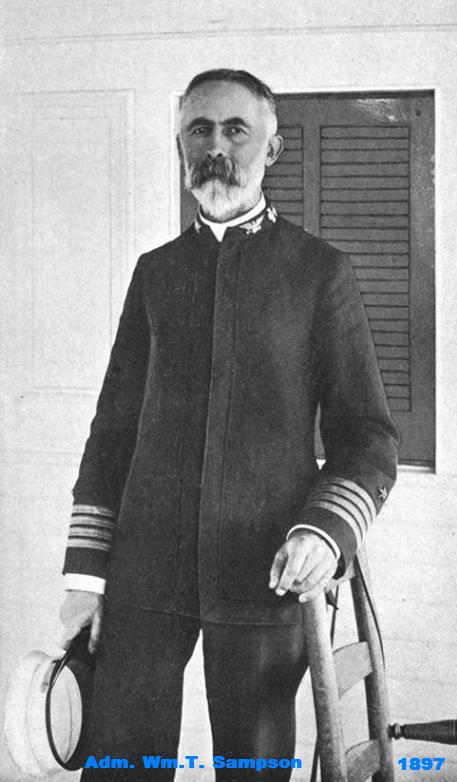
Perhaps even more interesting was the family Navy and Army lineage. Sam III's great grandfather was a Coastal Artillery officer at the turn of the century, and 2nd great grandfather was Admiral W.T. Sampson, a Naval officer who is well recorded in history...he was the Commander of the Navy force supporting Teddy Roosevelt in Cuba during the Spanish American War. A graduate at the top of his USNA class, Admiral Sampson served aboard a number of ships from a Civil War Monitor through a succession of larger ships until his last where he served as Captain of the Battleship Iowa (BB-4) in 1897. Afterward he commanded the North Atlantic Squadron during the Spanish American War.  Our Sampson Scott bore his name.

Thursday, November 18, 2010

Airport Molestation - A Suggestion


Comedian Dennis Miller offered a reasonable suggestion for the Airport Molestation situation last night on TV. I liked it.

Miller (paraphrased) said he didn't mind the naked scanner too much since he didn't have anything he was ashamed of under the cloth. However, he went on to suggest that since we have a significant medical problem getting people to participate in early cancer screening, and since we have already made a big investment in labor and equipment at our airports, let's reconfigure the machines to provide mammograms at the same time.


Brilliant

Airport Molestation - Touching Junk


During my military service I recognized that there was really no "they" in this world. "They" usually resolved into 1 or 2 individuals having decision authority over a given situation. I also observed that low level workers like to invoke the generic "they said" or "they told" as an impenetrable defense in the event that someone had had enough abuse or delay at the hands of a low level minion and voiced a strenuous objection.

"They" are really not prepared, nor do they want to deal directly with objections from the masses "they" are charged with serving. This is true of both government and corporate "they" authorities. In fact, in recent decades "they" at the top have erected elaborate fortresses designed to disguise just where and who "they" really are. Just try to quickly find where a CEO is located. Of course, it's a reasonable position in most cases that "they" not expose themselves to us, because "we" are not always correct, nor do "they" at the top have the time to deal with a high volume of us. That is what lower tier "they" are for. Assuming the top level "they" are not complete idiots, then it's amongst the lower tier "they" where the problems begin to arise. Lower tier "they" can run the gambit of very good to very bad, but it is still the responsibility of "they" at the top of the stack to control their subordinate "they."

Still with me? I always found it useful to dig into an organization to find "they" at the top and direct my ire at them with a written document. In both corporations and in government organizations written documents have a special protected status. Although the document can be destroyed it doesn't mean that it didn't exist. Destroying such a document can be problematic for a chieftain because a copy can often resurface at a later date. So a written document to the top "they" of an organization is nearly always retained and very often answered. It's a legal thing.

Depending on the quality of the response to your ire, you have a choice of dropping the matter or taking it further and to other audiences. If your ire is expressed as a "dammit" and the response is something like "screw yourself, very truly yours" then you have a great picture of what you are dealing with that you can wave far and wide.

Youtube and other online avenues are providing direct access to a lot of people that we never before had and "they" are only now beginning to learn the threat it poses to their business as usual approaches. I think it's great, but beware.  "They" will almost certainly move to throttle those avenues over time..

John Tyner, 31, took a stand at the San Diego airport a few days ago by refusing to have his junk touched in a physical search and was refused his boarding rights. John had recorded his encounter and posted it to Youtube within a few hours. It went viral and the furor rose so quickly that "they" could not ignore it. John may be a present day Patriot. In taking his stand he illustrated the effect of Airport Molestation that was going on and forced "they" out from their fortresses all in one short event. That's a remarkable feat.

I tend to dismiss younger guys like John as inexperienced and impulsive, but in his case I think he may be that horse of a different color. At 31, he is very young....Thomas Jefferson was 33 when he penned the Declaration of Independence; George Washington was 43; and John Hancock whose large signature is an icon on the Declaration was 39. In those days "they" were George III and his assorted subordinate "they."


Forward Freedom

Wednesday, November 17, 2010

SMU - Dallas

Pretty good clip from Dick Cheney commenting on the George Bush Presidential Library about to be built there....


Airport Molestation - Heat Rises

Bob Hoover, one of history's finest aerobatic pilots, used to fly at most of the LAX area airshows.  The shows were held at both commercial airports and military fields, most of which in that area were Naval Air Stations.  I think his first show plane was a yellow P-51 Mustang that was kept at the LAX airport in a North American Aviation hanger.  Stories of both his skills and his antics were already legend in the 1960s. 

As an early introduction to dumb government, even before my military service, I was subjected to an amazing display of bureaucratic dumbness at an airshow where Hoover would be flying his Mustang.  I got to NAS Point Mugu late and there was a line to purchase the 50-cent tickets.  Large temporary stands had been erected that effectively blocked view of the field except for a small slit between them.  Through that small slit I could see a yellow flash as Hoover's P-51 shot by; first one direction, then another.

The line was stalled because the 2 sailors selling tickets had run out of tickets and were waiting for a new supply.  Rather than just take the 50-cents and pass people through, the line was halted until some more tickets could be located.  I was fit to be tied--Hoover was doing the thing I had traveled a couple of hours to see and 2 sailors and whatever supervisor was there were in a classic brain-fart preventing me and a lot of others from seeing the main event.

Why the story?  In a sense, something like that is going on today within the TSA at our airports.  Bureaucrats, when faced with a situation requiring adjustment from the "rules book" tend to take the safe position and just point to the "rules."  That's understandable when one's livelihood is at risk; however, I think even many of those within the TSA rank and file know that in this case the rules need to be adjusted.  Is there evil intent at the top?  We all need to make that judgment ourselves.  Perhaps it's another example of Ben Franklin's warning about the "busybodies". 

Here is a link to an editorial out today--worth a read.  Drudge is linking to a lot of information on this matter.  I think it is a big deal.


Adios

Monday, November 15, 2010

Airport Molestation - CEOs


In his testimony before a Congressional panel following his ditching in the Hudson, Captain Sully Sullenberger succinctly summed things up. Years of “revolving door management teams treating airline employees like an ATM” had taken their toll on the airline industry. Placing a face with a CEO job is somewhat futile because before much time passes their faces will be replaced by other faces and the revolving door will simply keep spinning.

Expecting these temporary CEOs to “grow a pair” and object to the fondling of their customers by an out of control federal bureaucracy is just expecting too much from these kinds of men. These are the same guys responsible for stranding their passengers on hot tarmacs for hours, for enhancing their revenue by sticking it to you by the bag, for making “business” decisions to reduce costs by eliminating the peanuts, and for drawing multi-million dollar compensation packages for themselves each year.  Yes, I know they serve at the pleasure of the Board, but I also know that the Boards are often made up of a tight little group of cronies, some of them with notes pinned to their sweaters and their oatmeal drooling down their chins. 

Be that as it may, these are the men running the nation’s airlines today. Are you aware of any of them voicing objection to the molestation of their passengers? I haven’t heard them either.  It is not a CEO's job to look after day-to-day operations, but it is (or once was) his job to defend his company, its employees, equipment, and most of all...its customers. 

Capt. Sullenberger, shown below, is about as good an example of the consummate airline pilot as I can muster. His career started just after Vietnam and has spanned the period encompassing deregulation; his words bear re-reading...they are included at the bottom of the picture below.


Sunday, November 14, 2010

Airport Molestation - Chicago Tribune

This is really a pretty good piece published today...worth the read:

chicagotribune.com

Airport security: Government in our pants
Screening gets way too personal


Steve Chapman
November 14, 2010

When it comes to protecting against terrorism, this is how things usually go: A danger presents itself; the federal government responds with new rules that erode privacy, treat innocent people as suspicious and blur the distinction between life in a free society and life in a correctional facility; and we all tamely accept the new intrusions, like sheep being shorn.

Maybe not this time.

The war on terrorism is going to get personal. Very personal. Americans have long resented the hassles that go with air travel ever since 9/11 — long security lines, limits on liquids, forced removal of footwear and so on. But if the Transportation Security Administration has its way, we will look back to 2009 as the good old days.

The agency is rolling out new full-body scanners, which eventually will replace metal detectors at all checkpoints. These machines replicate the experience of taking off your clothes, but without the fun. They enable agents to get a view of your body that leaves nothing to the imagination.

A lot of people, of course, couldn't care less if a stranger wants to gaze upon everything God gave them. But some retain a modesty that makes them reluctant to parade naked in front of people they don't know, even virtually. Henceforth, Jennifer Aniston is going to think twice before flying commercial.

Besides the indignity of having one's body exposed to an airport screener, there is a danger the images will find a wider audience. The U.S. Marshals Service recently admitted saving some 35,000 images from a machine at a federal courthouse in Florida. TSA says that will never happen. Human experience says, oh, yes, it will.

For the camera-shy, TSA will offer an alternative: "enhanced" pat-downs. This is not the gentle frisking you may have experienced at the airport in the past. It requires agents to probe aggressively in intimate zones — breasts, buttocks, crotches.

If you enjoyed your last mammography or prostate exam, you'll love the enhanced pat-down. And you'll get a chance to have an interesting conversation with your children about being touched by strangers.

Reviews of the procedure are coming in, and they are not raves. The Allied Pilots Association calls it a "demeaning experience," and one pilot complained it amounted to "sexual molestation." The head of a flight attendants' union local said that for anyone who has been sexually assaulted, it will "drudge up some bad memories."

But the option of the full-body scanner is not so appealing, either, even leaving out privacy concerns. Two pilots' unions have advised members not to go through the scanners because of the possible risks of being bombarded with low doses of radiation.

"There is good reason to believe that these scanners will increase the risk of cancer to children and other vulnerable populations," a group of scientists from the University of California at San Francisco informed the White House.

Aviation trade groups fear the public has finally been pushed over the edge. "We have received hundreds of e-mails and phone calls from travelers vowing to stop flying," Geoff Freeman, executive vice president of the U.S. Travel Association, told Reuters.

The new policy is being challenged in court by the Electronic Privacy Information Center, which says it violates the Fourth Amendment's ban on unreasonable searches. But don't expect judges to save us. Says Stanford University law professor Robert Weisberg, with resignation in his voice, "Airports are pretty much a Fourth Amendment-free zone."

Though the harm to privacy is certain, the benefit to public safety is not. The federal Government Accountability Office has said it "remains unclear" if the scanners would have detected the explosives carried by the would-be Christmas Day bomber.

They would also be useless against a terrorist who inserts a bomb in his rectum — like the al-Qaida operative who blew himself up last year in an attempt to kill a Saudi prince. Full-body scanning will sorely chafe many innocent travelers, while creating only a minor inconvenience to bloodthirsty fanatics.

The good news is that last year, the House of Representatives voted to bar the use of whole-body scanners for routine screening. But only a sustained public outcry will force a change.

We will soon find out if there is a limit to the sacrifices of personal freedom that Americans will endure in the name of fighting terrorism. If we don't say no when they want to inspect and handle our private parts, when will we?

Steve Chapman is a member of the Tribune's editorial board and blogs at chicagotribune.com/chapman

schapman@tribune.com
Copyright © 2010, Chicago Tribune

Airport Molestation

For the past few days, Drudge and a couple of websites have been running full-bore with this story which accompanies the introduction of full-body scanners at US airports.  I don't know whether any other outlets have been dealing with it or not.  However, the outrage has grown so quickly and so vociferously that Janet (b.1957, a FBG), has had to crawl out of her cave and speak to the situation.

Both the Flight Attendants' and Pilots' unions have recommended that their memberships decline the intrusive searches.  As we approach the Thanksgiving and Christmas holidays the situation bears watching.  I would vote for a complete boycott of the airlines until this matter is reasonably settled.  But that's just me...I've never cared to put up with much bureaucratic crap during my lifetime--that includes corporate crap as well as governmental crap.

I'm not too sure of what I think of Janet.  She seems reasonably well grounded when I've seen her speak, but then again her name and mug seems to be repeatedly attached to one officious pile of crap after another.  She's the one, as I recall it, whose mug was attached to that paper that leaked out some months ago stressing that veterans pose a significant threat to the country's security, because of their military training.  That outrage exploded in her face and it had to be quickly retracted as a an unapproved draft written by some unnamed, low-level flunky.  There have been a couple of other events attributed to her, so I've begun to think where there is smoke, etc.

We grew up at a time and in a place where manners were taught and respect for others was the norm.  Common sense tended to be the norm also.  We weren't burdened by so much concern about hurting feelings of others...that would have been rude and subject either to some degree of censorship or a punch in the nose.  Shelby Foote, one of my favorite historians, frequently said that there was nothing so conducive to a polite society than the threat of a punch in the nose.  It's up to the younger generations now to hold on to their freedom...I hope they have the gonads; I'm not sure they do.

Some of our classmates flew as aircrew with the commercial airlines (Alice Bretz, Sharon Hubbard,  & Sharon Ballem come to mind).  Can you imagine what they might have had to say when some bag checker started to grope them?  I can.

Of course the aggressive hand searches are some bright light's notion of how best to drive (FBGs like that word...drive, they use it a lot) people into the full-body scanners...make the hand search so repugnant that the Sheeple will capitulate.  It's how thuggery works just short of taking out the blackjacks.

BTW, where are those FBG pillars of corporate prowess and leadership...the airline CEOs?  Haven't heard a peep from those cowards.


Adios

Thursday, November 11, 2010

Blue Angels - A Veteran's Day Salute

Climb aboard and take a ride with the very best of the best.

Well done. Carry on Gentlemen.