Wednesday, January 13, 2021

Six Flags over Texas

 cj64

The summer after the 11th grade (1963) I got a job at a truly magical place, Six Flags over Texas. In those days it had only been opened about 2 years. It was a theme park, not an amusement park with scary rides. The “six flags” referred to the flags that had flown over Texas during its long history – French, Spanish, Mexican, Texas, the Confederacy, and the US. So, parts of the park were devoted to each of those eras, some more than others. The French section, for example, featured the LaSalle boat ride and Lafitte’s pirate ship, while the Texas section was large and extensive and featured an old West town and railroad depot. The Confederate section looked like plantation houses and was centered on a huge fried chicken restaurant. It also had Skull Island, which was an island with a giant skull. You could slide from the top of the skull out through the skull’s mouth. It had dark pathways around the island and was a great place to take your date. It also had Indian canoe rides. The Mexican section was limited to an El Chico restaurant and the Sombrero ride. Spain had the Log Ride, a fun house where things rolled uphill, and curio shops. The US section, called the Modern section by the park, featured Humble Oil’s Happy Motoring ride and a train depot, plus refreshment stands. There was one more section just past Modern called Boom Town. It had mining town buildings housing souvenir and refreshment stands, plus the Mine Train ride. Tying the park together were the train, that ran the perimeter of the park; and the Astrolift, where you road a suspended bucket from Modern to Texas to see the whole park.


The park was extremely well-managed. Their training was excellent and lasted about 2 days just for the indoctrination. Their overall message – “We have no customers or employees. They are guests, and you are hosts. If you don’t treat them as your guest, we will fire you.” What we learned is that good attitude and good manners can be taught and can become habitual, and pays off with pleased “guests”.

Six Flags had 3 job organizations – Food & Beverage (eating and drink establishments), Operations (the rides), and Maintenance (cleaning and repair). They also had vendor operations, which were outside companies who operated at the park under lease arrangements, such as El Chico or the souvenir hat stands (more about them later).

I was hired into Food & Beverage and spent the summer of 1963 in the popcorn stands at a pay of $1.20 per hour. We had 3 locations you could work at – the big stand with multiple workers serving popcorn and cokes in the Modern section, and one-worker stands in a mining shack in Boom Town, and a vintage popcorn wagon in the Texas section. The latter two were popcorn only, no cokes. Modern was more fun as you could chat with your fellow workers, but the standalones were good for doing some serious thinking if so inclined.

We all wore uniforms. The standard for boys were white shoes, white pants, a blue-and-white or red-and-white striped shirt and white straw hat with a shirt-matching band. Fry cooks and table bussers wore a chef’s smock and hat with the striped design. Operations wore uniforms appropriate for their ride. Maintenance wore yellow shirts with orange pants and hats. The girls wore shirt-waist dresses with pink or blue stripes. I have to add that the girls must have been hired for their good looks. Gosh, they were pretty. Six Flags hired from all over the DFW area, and they were a pleasant bunch to work with.

Six Flags was open on the weekends in the spring and fall, and every day in the summer. In the spring of 1964, my senior year, I worked weekends and that summer bussing tables or as a fry cook in the Depot Café of the Texas section. You worked in shifts – the day from 8-4, or the night from 3-11. The night shift had its benefits as the park was beautiful at night and a little quieter. Sometimes we would organize a party after work and head for Lake Arlington, and some romancing might occur. That summer the Park had arranged for the famed Kilgore Rangerettes (the original drill team) to work at the park. They would perform their routines occasionally in return for park jobs and park-paid accommodations. They were all lookers with loads of personality and fun to work with.

In the summer of 1965 I worked for Howell Instruments. I got the job through Don Pipes’ dad, who was a VP there. It was actually a construction job, as the Howells had bought a beautiful mansion in Rivercrest (built in 1912) and they used Howell workers to do a lot of the tear down. My main job was knocking down a 3-foot thick rock and mortar outer wall. The tool was a 110-pound jackhammer. At the time I weighed about 160 pounds. I would lift that hammer up and stick it against the wall and pull the trigger, then repeat, all day. At the end of the summer the wall was gone and I weighed 180, mostly in my chest and shoulders.

It was back to Six Flags in 1966. This time at the souvenir hat stands. Ken Huddleston got me the job as he had worked there the year before. We sold all kinds of novelty hats and had stands in every section. The fun part was learning how to sew names on the hats. We had a sewing machine that had a rotating handle underneath the counter. You would hold the hat with your left hand and twist and turn it as needed while you were rotating that handle to guide the needle. It required considerable practice to learn and the progress was usually in these stages – 1) you couldn’t do it 2) you could do it but the result was unreadable, and 3) you could do it and the result was OK.

The big test was on a busy day where one guy would man the machine and the other guys would toss the hat to you for name-sewing. They would toss a sailor hat (called “gobs) to you and yell out the name. You would sew it on and toss it back, yelling out the name again. After an hour of this you got good at it, but the first hour was a mess with lots of re-sewing.

We had a lot of fun with this operation, I guess just to keep it light-hearted, such as – the host would ask the name, and the guest would say “Jim”. The host would toss the hat to the guy at the machine and yell out “Jim, G-Y-M”, misspelling it on purpose. The sewer would yell back “G-Y-M” then start sewing J-I-M on the hat and toss it back. All the while the guest is protesting like crazy, until the host handed him the hat and they would grin big time. Sometimes they would keep re-reading the hat to make sure it really was “Jim”.

Also, people were always asking directions, and we noticed they rarely listened to us but would pay a great deal of attention to where we were pointing. So they would ask, “Which way to the Astrolift?”, and we would point in that direction and say “Just past the chyser on the timex!”, or some other nonsense and they would take off happily. It sounds silly now, but it kept our spirits up.

We learned a great deal about people, as individuals and in crowds. For example, most people expected July 4 and Labor Day to be extremely crowded, so they wouldn’t come that day. As a result, July 4 and Labor Day were practically empty. I even went home early one July 4. But, the Sunday before Labor Day was the biggest day of the year and we would extend the park’s hours to a midnight closing to accommodate that crowd.

And, we learned that people were always pleasant if you were pleasant to them. The exceptions were extremely rare.

We had a function at the park that proved to be very much appreciated. It was called Lost Parents. That is where we placed the lost kiddos. The procedure to be followed when a crying child came up to you was to comfort them, pick them up if small, find the nearest security guard (dressed in white pants, blue tunic, and white pith helmet), and turn the child over to them. He would take the child to Lost Parents, located in the headquarters area, where nurses and nannies were waiting to take care of them. The inquiring parents, wherever they showed up, were directed to Lost Parents for the reunion.

Every section of the park had theme music playing in the background over hidden speakers, and it varied by section. In Modern, they played a lot of music from Camelot, for example. In Texas, it might be “The Green Leaves of Summer”, from The Alamo. Wherever and whatever it was, it gave you an opportunity to stop and reflect on the music and recall the memories music always generates in people. It might be quiet where you were, and it was night with a moon and a breeze, a family would stroll by, and one of the pretty girls would walk by in her striped dress, and the music would make you wonder if she was in your future. Magic is like that, and the park could produce it in abundance, but you had to watch for it.  

Wednesday, December 25, 2019

A Poem - Bob Dillard, a tribute by Kendall McCook

A tribute to an old friend of over 60-years ...


... in text:

28 July 2019
Bob’s Pass Over

More than a week since old friend Bob Dillard’s goodbye
Saying a sad “so long” to that Blue Mountain man
Who worked and strolled days and nights
Of his own free successful choosing
Meeting friend and foe as equal

In the days before he left us Bob drove
Sleepless over to El Paso to catch a plane
With his old and constant compadre Larry Guthrie
Bound for La Paz where they walked the tropical
Roads and drank cerveza with lifelong buddy Paul Tate
Who now enjoys dual citizenship and permanent residence
In Mexico where he still plays trumpet in a local jazz band

Bob remembered the trip fondly but said it was
A hard road
Then came the busy traditional July 4th Fort Davis
Celebrations and barbecue brisket smoking and sale
Bob’s last photo shows him in his barbecue apron
Black dusty cowboy hat pulled back happy smiling
Smoking those briskets, more than 50 sold
Then came the wedding party and forty
More briskets for the hungry folk crowd

And there was the sudden death of
His trusted and constant canine companion, Gabby
And the front page story and obituary of
Hundred year old civic leader Vera Bloys Grubb June 8th
And then the school board seminars in San Antonio
And the breakdown after these sorrows

And on the front gate of his friend John’s Olympia Hat Shop the banner
“ Trump 2020 – Keep America Great” in red, white, and blue

Too much to handle at seventy-four. His strong body said,
“Whoa!” And the unexpected end came soon
After a Careflight from Alpine to a hospital in Lubbock
And several days in a coma, he finally
Passed Over

He died at the top of his game
Still sittin’ tall in the saddle
Still ropin’ still writin’
Still befriendin’ the people
Still makin’ the next edition.

Sunday, July 28, 2019

Robert Allan "Bob" Dillard II


Gus recalls:  Before leaving EHHS for the rest of his life, Bob left a short expression of his hopes and aspirations for the future.  


Wednesday, June 05, 2019

2019 - D-Day June 6, 1944 - 75th Anniversary

Everyone embarking in the morning will get a copy of this letter to carry with them.


Monday, January 09, 2017

Looking Back—Handley and Handley High School

                               1938 Handley Downtown
            (showing businesses attributions for early 1960s & Hwy 80)

On December 20, 1849, Tarrant County was founded and named after General Edward H. Tarrant, who had been instrumental in driving out the Indians. Tarrant County was formally organized in August 1850, when the first elections were held. The railroad arrived in 1876 and the rail line that extended to the Dallas area resulted in Handley and Hayterville (later renamed Arlington) coming into being. Handley was named after Major James Madison Handley of Georgia. After the Civil War Handley moved to the area while employed as a traveling salesman.

The first Handley School was built south of the Texas and Pacific tracks in 1877 and was located at the corner of Daggett (now Forest Avenue) and Main (now Hart Street). It was initially an ungraded school with one teacher. Later the building was expanded to accommodate more students. About 1898 construction of a new school building began on the corner of Forest and Church Streets where the old Masonic building now stands. That school was completed in 1901.

That same year Tarrant County Commissioners approved the creation of the Handley Independent School District. It operated from 1902 until 1928 when it was annexed by the Fort Worth Independent School District. Seven men were elected as trustees for the new school district: John Joseph Ferrell, William Pitt Craig, William David Weiler, William Louis Hunter, Richard Ladd, Thomas Kell, and Jacob Cook. Each of these men were buried at Rose Hill Cemetery (established in 1928) Major Handley is interred there as well. In1909 a larger school, constructed of red brick with white stone trim, was erected at 3127 Chilton Street. It was used for both elementary and primary grades until 1922 when a second brick building was built at 2925 Haynie Street that housed the Handley School from 1922 to 1959 (when the last class graduated from Handley High School).

An essay in the 1928 Handley School Yearbook reveals that the yearbook (sometimes referred to as an annual) had its origin back in 1920 connected with the creation of a school newspaper to document activities of school life. The school paper was to be called the Skyrocket. However, when the publication came about it was named "The Guidepost," but only the initial issue was so named. Over the course of the next three years (1921, 1922, 1923), a semi-monthly publication called "The Skyrocket" was created to document school activities. It was in 1924 that the first annual, a "neat" fifty page booklet, was printed. In the year 1925, "The Skyrocket" appeared rather irregularly, but the best final edition that had ever been published, it was said at the time, appeared at the close of the school term.

At the beginning of the 1925-1926 term, "The Skyrocket" was discontinued because the Handley News began devoting a portion of the space to the school reports. However, popular demand among the students resulted in "The Skyrocket" being reinstated. Curiously, the 1930 yearbook was called "Greyhound," but the football team continued to be called the Rockets. Then for some reason the name of the yearbook was changed in 1931 to "Orion" while the sports teams began using the Greyhound emblem. The 1931 year seems to have been the only year for an Orion yearbook. The yearbook for 1932 took the form of a scrapbook. Except for the years 1933, 1934, 1935, and 1936 when no yearbooks were published, Greyhound continued both as yearbook and as the school emblem until Handley High School was closed at the end of the 1959 school year.

Around 2009 (the 50th anniversary of the last graduating class of Handley High School) an effort was undertaken to find and scan as many of the Handley yearbooks as could be located. A total of 28 yearbooks were located and scanned—essentially all that were produced except for 1926, 1929, and 1939 (and the years no yearbooks were produced). Two complete sets of the scanned yearbooks have been produced (both 4-volume printed versions and digital versions of the complete set) and have been deposited with the Billy W. Sills Archive of the Fort Worth Independent School District and with the Fort Worth Genealogical Library, respectively. A third set has was produced for depositing with a suitable repository in the Handley area whenever one is located.

The yearbooks provide a wealth of insight about the history of Handley people. In the 1927 yearbook you can read the interesting guidance from the School Superintendent to students and teachers. You can read about activity groups such as "Declaimers" and "Debaters." The 1928 issue of the Skyrocket boasts that "ninety percent of the 186 students who have finished here are or have been in college." That seems to be an amazing feat for those days. Are we that accomplished in these days? 

An index of all seniors from all of the years collected is included with the yearbook sets that includes in some cases burial locations of our deceased alumni in the form of Find-A-Grave memorial numbers. A document with links to each of the yearbooks for downloading can itself be downloaded at: http://tinyurl.com/qyy8yfh.

David McConnell, Handley High School Class of 1959


1950  Handley business district

Wednesday, May 25, 2016

Yes Dear is Ill – And so is Gus

We’ve been blessed over our 40-odd years together….we don’t get sick much.  But, when we do, inevitably an ancient contest between us erupts.  The contest…which of us is the sicker…is really an exercise to determine which of us is going to get the first and most complete pampering from the other during our emerging discomforts. 


This year, it’s a particularly nasty little, late-season flu bug.  Yes, we got the fall shots…those “enhanced” versions that were purported to cover 8 or 10 “new” strains….or, maybe that was the pneumonia shot…I forgot which.  About 3-days of feeling crummy, followed by a couple of weeks of endless sinus drainage and coughing.

Now, our particular minuet has no organized rhythm; it being an ad hoc undertaking from the beginning sniffles, coughs, and aching joints.  But, from the very beginning of our life together, Wife displayed her usual competitive temperament.  She quickly demonstrated that she intended to be the first of us to be sick each season and, if not the first, she would damned sure be the sickest. 

And so it has been over the decades…..I’m first to get sick and she quickly trumps me….No by damned, SHE’s the sickest.  My protests have always been futile and so, she’s always gotten the greater share of pampering.  Trouble is, Wife is a demanding patient and this year, she got it first and promptly gave the bug to me.  


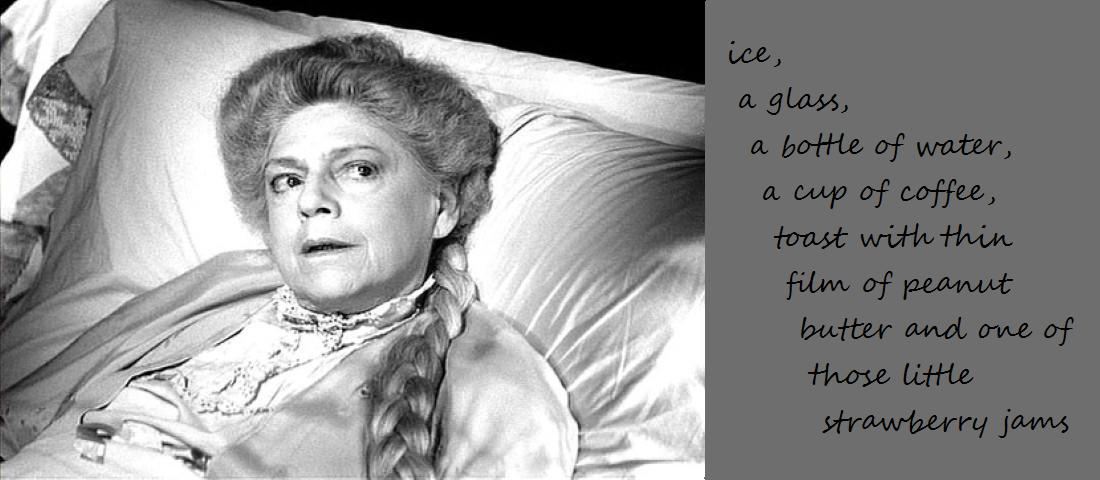
As a demanding patient, she can also be a monumental pain-in-the-ass…such as she has been during this most recent bout.  I go in to see how she’s doing and ask if she wants or needs anything.  She gives me a list…..ice, a glass, a bottle of water, a cup of coffee, toast with light coat of peanut butter and one of those little strawberry jam bottles she ordered from France for God knows what reason.  Now, for most of my life, I have not devoted any effort in trying to remember lists, numbers, or other such short-duration material...the theory being, leave the brain free to think rather than cluttered with much factual minutia.

Years ago, as we were in the early phases of establishing our respective domestic territories, I suggested that she use a little crystal bell to let me know if she needs something.  That was a big mistake….that damned bell was ringing constantly until I threw it out.  


Anyway, we're headed into the summer so, it's time to get the eyes checked for the beach season....another sure way to ..... well .... and it's great that our little sob of a bug has departed leaving us none the worse for wear.  The kitchen has heated up again, wife is back in gear.  Life is good.

So, we’ve evolved into a kind of equilibrium as I suppose most married couples do….one of mutual respect, concern for the other, and a form of rueful capitulation to the other.  Well anyway, it’s been 6-years since she saved my life and I suppose it’s only fair that she get the greater share of pampering….but she will never again get another bell !


--Adios--

Monday, January 11, 2016

For Reference - North vs. South Legacy

The pages posted to this article are scanned from an October 1991 issue of American Heritage magazine.  Since childhood in Texas, I had an ongoing curiosity about the substance and origins of the regional differences between us Cowboys and those Yankees.

After traveling fairly extensively and working for a few decades with a lot of real, live Yankees I had the opportunities to gain first hand experience dealing with and observing those differences. It took nearly 30-years after leaving Cowtown to find a clear and rational discussion of the phenomena put down in print.  The pages that follow are about the best I ever found on the subject.


Credit and appreciation to American Heritage Magazine, October 1991

Sunday, October 25, 2015

ACROSS THE CONTINENT - 1878 The Frank Leslie Excursion to the Pacific

This article is included here as background information to describe train travel conditions about the time that Ft. Worth got its first rail service in 1876.  The intent is to provide a glimpse of what our Cattle Barons and other assorted early Fort Worthians likely experienced as they ventured out from their prairie homes to see the larger world beyond.

New York publisher, Frank Leslie himself, wrote of his 1878 journey from New York to San Francisco taken just a few years after the Golden Spike was set at Promontory Point joining the East and West coasts together for the first time.  Although his descriptions tell of his numerous tribulations, railroad travel was revolutionary in its day.  Journeys that formerly took weeks to complete, suddenly could be done in 4-5 days, coast to coast with the engines chugging along 24/7 making about 35 mph on average.

Credit for the following goes to:  


FROM our Pullman hotel-car, the last in the long train, to the way-car which follows closely on the engine, there is a vast discount in the scale of comfort, embracing as many steps as there are conveyances.  It is worth one's while to make a tour of the train for the sake of observing these differences and noting the manners and customs of traveling humanity, when tired bodies and annoyed brains (there are plenty such even on the overland trip) have agreed to cast aside ceremony and the social amenities and appear in easy undress.  The old assertion that man is at bottom a savage animal finds confirmation strong in a sleeping-car;  and as for the women — even wider dear little five-and-three-quarter kids, the claws will out upon these occasions. For here, at 9 P.M., in the drawing-room steeper, we find a cheerful musical party bowling, "Hold the Fort!" around the parlor organ, which forms its central decoration; three strong, healthy children running races up and down the aisle, and scourging each other with their parents' shawl-straps ; a consumptive invalid, bent double in a paroxysm of coughing ; four parties, invisible, but palpable to the touch, wrestling in the agonies of the toilet behind the closely buttoned curtains of their sections, and trampling on the toes of passers-by as they struggle with opposing draperies; a mother engaged in personal combat (also behind the curtains) with her child in the upper berth, and two young lovers, dead to all the world exchanging public endearments in a remote corner. Who could bear these things with perfect equanimity?  Who could accept with smiles the company of six adults at the combing and washing stages of one's toilet?  Who could rise in the society, and under the close personal scrutiny of twenty-nine fellow-beings, jostle them in their seats all day, eat in their presence, take naps under their very eyes, lie down among them, and sleep — or try to sleep — within acute and agonized hearing of their faintest snores, without being ready to charge one's soul with twenty-nine distinct homicides?

But if the "drawing-room sleeper" be a place of trial to fastidious nerves, what is left to say of the ordinary passenger-car, wherein the working-men and working-women — the miners, the gold-seekers, the trappers and hunters traveling from one station to another, and the queer backwoods folk who have left their log homesteads in Wisconsin and Michigan and Illinois to cross the trail of the sunset —— do congregate, and are all packed like sardines in a box?  It is a pathetic thing to see their nightly contrivances and poor shifts at comfort ; the vain attempts to improvise out of their two or three feet of space a comfortable sleeping.  Place for some sick girl or feeble old person, and the weary, endless labor of the mothers to pacify or amuse their fretted children.  Here and there some fortunate party of two or three will have full sway over a whole section — two seats, that is to say — and there will be space for one of them to stretch his or her limbs in the horizontal posture and rest luxuriously ; but, for the most part, every seat has its occupant, by night as well as day, a congregation of aching spines and cramped limbs.  The overland journey is no fairy tale to those who read it from a way car !

We climb into the baggage-car sometimes to admire the orderly-piles of trunks and valises andboxes, to peep at the queer little corner fitted up as an armory, with its gritted door and assemblage of deadly weapons held always in readiness for a possible attack upon that store-house of many treasures ; or we take a furtive glance at some pretty girl who has been seized with an unconquerable desire to explore her trunk, and who — under close surveillance of the baggage-master, who is no respecter of persons — is turning over the trays to rummage out a handkerchief or a clean collar, or perhaps a hat in place of the one which a gust of wind just now sent whirling over the Plains into some Pinto lodge.

Among the "side-scene"sketches which our artists scratch down by the way, the Chinese roadmenders come in; we find a constant amusement in watching them along the route from Echo Cañon to Reno, where whole groups of them dot the roadside, bare-legged, ragged, dressed in a sort of hybrid mixture of Chinese and Caucasian styles, with their pig-tails twisted up out of the way, and their great straw platter hats tied under their chins.  They are by no means the smooth, immaculate wellshaven pictures of neatness which greet our eyes in the dining-saloons — on the contrary, they are evidently of the lowest caste of Chinamen, with stupid, half-brutal faces, and dirty and unkempt though still, in these respects, falling far enough short of the Irish or German laborer.  They work diligently as beavers along the route, traveling from point to point with their tools on a little hand-car, which they sometimes hitch fast to our train, and then we, on the rear platform, find an ever-fresh delight in looking down upon them, laughing, and pelting them with "pigeon English," to which they scorn a response, but sit cackling among themselves in their own queer chopped-up language, replete, probably, with opprobrious epithets for the "white devils."

Note:  The above is one complete article published February 9, 1878, in Frank Leslie's Illustrated Newspaper,  from the July, 1877 - late 1878 multi-part series on "The Frank Leslie Excursion to the Pacific Coast."  The vivid description of this transcontinental excursion on the Pacific Railroad by Frank Leslie and his wife, Miriam, captures the experience of travel on the CPRR as well as the regrettably commonplace prejudices of the 19th century.   Frank Leslie's technological innovation, a dramatic speed-up in wood block engraving, made possible the illustrated newspaper, of which Frank Leslie's Illustrated Newspaper and Harper's Weekly were preeminent.  Leslie realized that large wood block engravings could be prepared fast enough to appear in a weekly newspaper by drawing the entire image onto a single wood block, then cutting it into rows and columns of smaller blocks each of which could be simultaneously hand engraved by a separate engraver.


Frank Leslie’s cross-country trip report broaches the topic of various classes of travel on the same train and illustrates the “coach” class most likely taken by many of our early Fort Worthians when they decided to go somewhere.  We packed our trunk, put on some comfortable, yet proper traveling clothes, gave the conductor our ticket and climbed aboard to chug off over the northern horizon at 35 mph for hours and hours and hours.

During those early Ft. Worth days of the 1880s and 1890s, our most likely destinations were St. Louis (a 19-hour trip); Chicago (a 28-hour trip); and New York (a 45-hour trip).   St. Louis and Chicago had the big meat packing plants and New York had the money and plenty of restaurants where our beef was consumed (more about them just ahead).

George Pullman, a self-taught western New York Engineer, who had lived and worked on the Erie Canal in his early life, had moved on to Chicago shortly before the Civil War.  He was in the perfect location to observe the rise of railroad travel to far-away places and make note of how long those journeys were.  He brilliantly combined his canal boat experience with the rising need for comfortable rail passenger accommodation and invented his “Pullman” sleeper cars. 

They were finished in various degrees of comfort, then leased to the railroads, complete with a Negro staff.  Pullman correctly reasoned that the recently freed slaves of the post- Civil War South would make excellent service staff for his cars and time proved him right.  He rapidly became the largest employer of freed slaves in the country.  And what’s more the Pullman porters treasured their positions and became highly respected pillars of their own communities throughout the nation.

Pullman’s cars ran the rails until the 1960s when rail passengers moved away to jet airline and personal automobile travel.  So, we just missed the opportunity to experience the highly refined rail travel as it had developed over the company’s 102-year history.  However, there are a few travel clubs and restored Pullman cars still in existence where a dedicated rail fan might find a current version of the experience.  The pictures that follow show a few fully restored cars that well illustrate the travel experience our Cattle Barons might have had when they ventured “back East” to catch steam packets for “the Continent” or just see the big city for a visit.


....hang on Gotham...we're on our way....


...Next, Gotham, THE Mrs. Astor, and some Vanderbilts....

Wednesday, October 07, 2015

The EHHS Social Order – 11.2.4 – Early Cowtown Society - Quality Hill


If the upshot of the railroad coming to town was the ready availability of outbound transportation for Fort Worthians—all 500 of them at the time—it was also the gateway for thousands of people living north and east of us who had been reading of the “Wild West” in their local newspapers and dime-novels of the day.  Within 10-years, our population jumped to 6600 and after 20-years, in 1890, it was 23.000.  Our little town was booming and the railroad made it possible.  As the sequential maps above reflect, our entire country had been largely “wired-up” by 1890.

Essentially none of Fort Worth’s Cattle Barons were born to wealth and when they started moving to town after working their ranches for about 25-years, they had the task of having to learn how to live to their levels of accomplishment.  And what better way to start effectively living up to their stations than to build a grand house in Fort Worth's very first "upscale" neighborhood, Quality Hill?"  A section of land located just southwest of downtown and today, other than for a couple of surviving relics such as Waggoner's Thistle Hill, covered by Ft. Worth's "hospital district" the area is difficult to find on casual inspection.  The 1891 "birds-eye" drawing below pretty well illustrates the area (outlined in red) at the time.


The very first cattleman to build a home on Quality Hill was R.D. Hunter, a Scotsman via Missouri who had come to America in 1843.  After having been a gold miner during the California gold rush period, Hunter saw promise in the post-Civil War free-range cattle business and stopped off at Texas to give the business a try.  Success and fortune followed and Hunter, like many others of his day decided to make the newly developing Fort Worth his later-life home.  Ultimately Hunter, with the aid of the T&P railroad, founded a coal mine about 60-miles west of Fort Worth at Thurber and a side business of making brick with the residue coal not taken by the railroad.  His Thurber bricks were the ones we recall driving on as they covered our downtown streets and on some of the early brick highways that were still paved with their original brick surfaces…Highway 80 to Weatherford, for example.  His grand home was built in 1897 at the corner of Summit and El Paso.

For the most part, the mansions of Quality Hill were built by men who had not been born with silver spoons in their mouths (although one—George Reynolds—long carried an iron arrowhead in his back). Two of the most successful began their careers as cattle trail cowboys (Samuel Burk Burnett, William Thomas Waggoner); another began as a Pony Express rider (George Reynolds), and still another began as an illiterate woodchopper (Winfield Scott).


Summit Avenue just as easily could have been called “Cattleman Avenue.” Among the cattlemen with fine homes along Summit Avenue were John Bunyan Slaughter, William Thomas Waggoner, Cass Edwards, Colonel C. A. O’Keefe, brothers William and George Reynolds, Samuel Burk Burnett, and James H. Nail. Likewise, Penn Street could just as well have been called “Bankers Boulevard.” Bankers on that four-block street included W. H. Eddleman, Otho S. Houston, Major Khleber Miller Van Zandt (also a lawyer), and C. H. Silliman.

Pennsylvania Avenue had a bit more variety. Winfield Scott who listed his occupation in the city directory as simply “capitalist” (in boldface), was Fort Worth’s biggest taxpayer. Also on Pennsylvania Avenue were three cotton brokers (Neil P. Anderson, Hermann Frerichs, and T. B. Owens) and four bankers (H. C. and W. R. Edrington, H. B. Herd, and G. E. Cowden).

As the Cattle Barons built and moved into their Quality Hill mansions during the late 1890s, Fort Worth finally had some venues large and fine enough to host some fancy soirees that might have become the genesis of our 1950s Meadowbrook Minuet but, I don’t think so…not yet.  A couple of Winfield Scott hotels, the Metropolitan and the Worth, were built near the end of the decade that would have had large enough public spaces to hold a large party but, I'm not sure that many of us knew how to do it yet.  Still, there were no paved streets yet, nor any automobiles, although a streetcar system was pretty well developed by now and we had some electricity.  Fort Worth was developing into a working man's society with a few manager-types moving in to help keep the books straight.

After the large growth seen the decade before, Fort Worth’s population growth slowed considerably during the 1890s.  It appears to have been a time of organization and consolidation of the City infrastructure itself, as well as a time of changing of the guard as the older Cattle Barons were mostly in or approaching their retirement years when they built their mansions.

As younger leaders emerged, it became clear that although some of Fort Worth’s leading citizens had earned substantial wealth, none of them were “to the manor born” in an East Coast sense.  However, since the arrival of the T&P Railroad about 20-years earlier, an inflow of people, news, and new ideas had been contributing to the maturation of our Chisolm Trail campsite.  And some of our leading citizens had taken the opportunity to travel “back East” to see for themselves, the big cities they had been hearing about.  But, we had a long way to go to catch up with magical places like Chicago, where much of our cattle herds headed for processing and New York, where a lot of our beef was consumed and where Jay Gould and the T&P Railroad money originated…..

Chicago 1870--before the great 1871 fire destroyed much of this...

Fort Worth 1890--a rare shot of the Texas Spring Palace..up 2-years, then burned down.

Fort Worth 1899 - 10th Street viewing east..Houston shown above, is 2-blocks ahead and Hell's Half Acre starts on the right side of 10th St.

Plainly, although some of us had some money, we weren't quite ready to work on getting our own Cowtown Society up and running just yet...and forget about minuets out on the lawn...for now, anyway.  It would take a few more years of Summers and 35 mph train rides "back East" for some of us to start developing our own notions of how Cowtown Society ought to work.  And in 1900, what better place to start learning than in New York City?  After all, weren't the Astors and Vanderbilts going at one another for the top spot in NYC society about then?  Why, yes they were....and that story is next....

Circa 1900:  
Fort Worth population.............26,700
New York City population...3,400,000


Next, The NYC Connection and "The" Mrs. Astor's famous 400

Monday, September 21, 2015

The EHHS Social Order – 11.2.3 – Early Cowtown Society - After the T&P


It’s difficult to find early pictures of Ft. Worth taken during its formative years following the 1876 arrival of the T&P Railroad.  For one thing a small, dusty village of just a few hundred frontier stockmen was of little interest to photographers having the requisite “modern” photo equipment…the gear was bulky and difficult to transport over long distances.  Thankfully, there are number of miscellaneous images in circulation that do provide random snapshots of the small town that help describe how the town was developing from 1876-1895.  Taken from a Penn Street home in 1885, shown above is the earliest known photograph of what was the developing skyline.

Thankfully, the early Ft. Worth builders did manage to establish one City view that has remained substantially unchanged for over 130-years; that being, Main Street either north to the Courthouse or south to the rail yards with some occasional off-axis views to fill-in the texture detail.  Countless photographers, both professional and amateur, have taken those pictures from various vantage points along Main Street such that a collection of them really does a good job of illustrating the growth and changes over that period of time.

With the coming of the T&P railroad, Fort Worth became the cattle shipping center for all those Texas free range cattle that had been driven up the Chisolm and other trails to the Kansas railheads.  In addition, the rail line provided much easier access to the country’s newest frontier lands from the much larger population centers of Chicago and New York.


A young (27) Frederick Remington’s amusing letter home to his girl friend suggests one young man’s feel for the place, circa 1888.

Sunday July 1, 1888

My dear girl,

Here I am at last—leave in the morning by stage for Fort. Sill—spent a day in Fort Worth with Hough—had a devil of a time—the mosquitoes like to eaten me up—there is not a square inch on my body that is not bitten—and oh oh oh how hot it is here—I have sweat and sweat my clothes full—I can fairly smell myself—I am dirty and look like the devil and feel worse and there is no help for me.

Well you can bet I am going to make the dust fly and get through as soon as I can—This is a miserable little frontier town with a little hen coop of a hotel—I am nearly starved to death—This Texas grub is something frightful—and my room—I wish you could see it.  You would smile—I fully agree with Phil Sheridan “If I owned Texas and hell, I would rent Texas and live in Hell.”—

Well all this is very discouraging but it’s an artist’s life.  I have no idea how long this thing will take for these Indians are scattered all over the earth but I “touch and go” and you can bet I won’t spend the evening with them—still I came to do the wild tribes and I do it.

Love Missie
Your Old Boy,
Fred


Now, while Remington and Russell were venturing out into the Indian Territories to record what they saw and create their artwork, a young Amon Carter about age 10, who would become perhaps the most important influence on what Fort Worth would become, was growing up in Crafton, about 60-miles northwest of town.  Carter, together with his future friend, oilman Sid Richardson, were too young to have known Remington and Russell during their prime years, but would later enthusiastically embrace and collect their art.  Those collections reside in Fort Worth museums today and form perhaps the greatest accumulation American Western Frontier Art in the world.  More on them later.

Frontier cattlemen started building “city” homes in Fort Worth during the 1890s that dwarfed all residences that had been built during the previous 30-years of settlement.  The earliest large homes went up a little north of the Courthouse on Samuels Ave. and since they were built of wood, nearly all of them have either burned or rotted away.  Only the Garvey house remains today as a reflection of what once was.  Moving to Fort Worth made sense for the regional Cattle Barons.  Their herds had been shipped out from there since the T&P came to town in 1876.  Setting prices and making the deals was done right there in town at the Exchange and the money flowed through Van Zandt’s bank, among others.

With a rapidly growing population, Ft. Worth was quickly developing some of the more refined creature comforts the large cities back East had been enjoying for about a generation by the 1890s.  Waggoner and Burnett both had private rail cars they used for travel.  There were probably others…an interesting research project to find some pictures might be in the oft.  But, for most folks, it was the large homes they built in Quality Hill that left the lasting impressions.

...and, Van Zandt had managed to help cure the lack of any saloons in town...by 1886, there were 68 recorded in the City Directory.


...next, Quality Hill residents and details...

Tuesday, September 15, 2015

The EHHS Social Order – 11.2.2 – Early Cowtown Society - Cattle Drives


1865-1880s.   At the end of the Civil War when millions of (Spanish) longhorn cattle were left on the plains of Texas without a market, the Union Pacific was building west across Kansas. Joseph McCoy, an Illinois stockman, believed these cattle could be herded north for shipment by rail. He built yards at Abilene, Kansas and sent agents to notify the Texas cattlemen. In 1867 the first cattle drives came up the Chisholm Trail and during the next five years, more than a million head were received at McCoy’s Abilene rail head.

Settling near Dan Waggoner’s ranches on the North Texas open range was Samuel Burk Burnett, a 19-year old young man closer in age to Dan’s son William Thomas, than to Dan himself.  During the ensuing 25, or so years, the Waggoners and the Burnetts built their herds and their fortunes driving tens of thousands of cattle to market each spring.  Their cattle drives and those of many other open range ranchers caught the imagination of the generations to follow as being the last days of our western frontier and of the American cowboy.  Burnett’s ranches, located just west of Waggoner’s, grew in several parcels to total about 350,000 acres at their peak.


It would be the next generations of Waggoners and Burnetts, along with a number of other open-range ranchers who, as they aged and prospered from their cattle businesses, would move to early day Ft. Worth to build their spacious city homes during the waning days of the 19th century.  But before anyone in Ft. Worth could start dancing a minuet out on a lawn, a city would have to be built first.

The Chisolm Trail passed right through Fort Worth which offered transient cowboys a convenient waypoint while driving their South Texas herds through on their way to McCoy's Abilene, Kansas rail headFt. Worth provided them an opportunity  to reprovision, rest their stock, and blow off some steam.  The constant stream of cattle and cowboys contributed to at least two very early civic improvements toward the establishment of Fort Worth as a city of the future.  First, Van Zandt’s note of there not being a single saloon in the town was soon rectified and next, a permanent settlement of sorts began its existence on the south end of what would some day be downtown….Hell’s Half Acre (HHA).  Remnants of Hell's Half Acre were still standing in the southern part of downtown when we were kids....and the area is now largely covered by the Tarrant County Convention Center.


1876.  New York financier, Jay Gould, was the ramrod behind pushing the rail line south from Kansas into Texas.  First, the line came into Marshall, then Dallas by 1873, and after the bank panic of 1873 had passed…into Ft. Worth by 1876.  The arrival of the railroad was the first significant link to a larger world than Ft. Worth had ever seen.  Our population then was about 500-600 people.

Of course, all of us learned of the Golden Spike joining the very first Transcontinental railroad in 1869 at Promontory Point in Utah but, understanding the significance of the arrival of rail lines into the country’s hinterlands was probably lost on most of us.  Think of it this way, after the Civil War, New York City was the center of most United States commerce…it was like the stout tree stretching toward the sky, it’s root system hidden out of sight below the surface.  As the map below shows, the railroads acted very much like that tree’s root system by connecting the rest of the country and its products to the trunk…NYC ! 


And once we had more efficient transportation leading to the big city than horse-drawn stage coaches, the possibility of some of us learning the minuet was substantially improved but, we weren't there yet.


Next -  Quality Hill