Showing posts with label Teachers. Show all posts

Wednesday, September 05, 2012

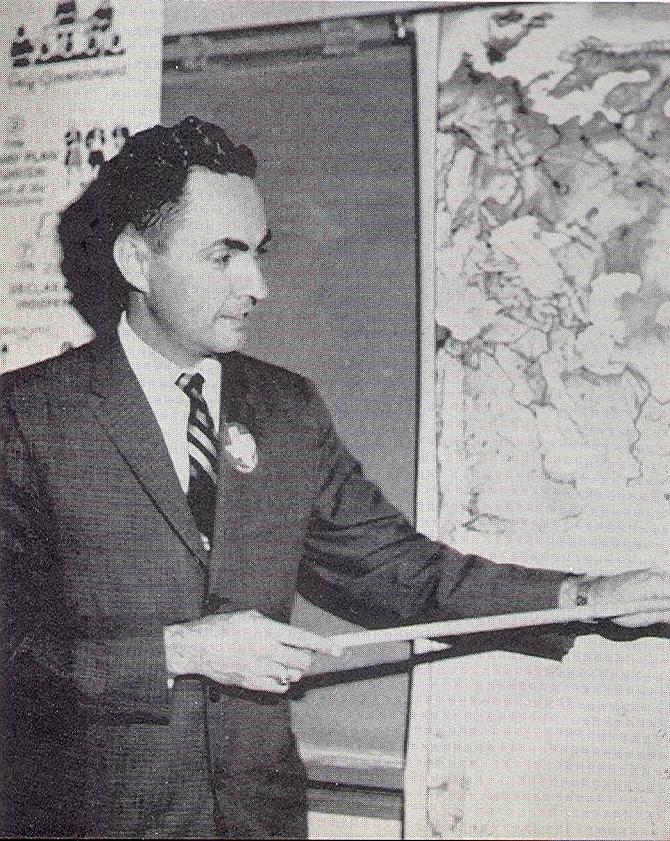
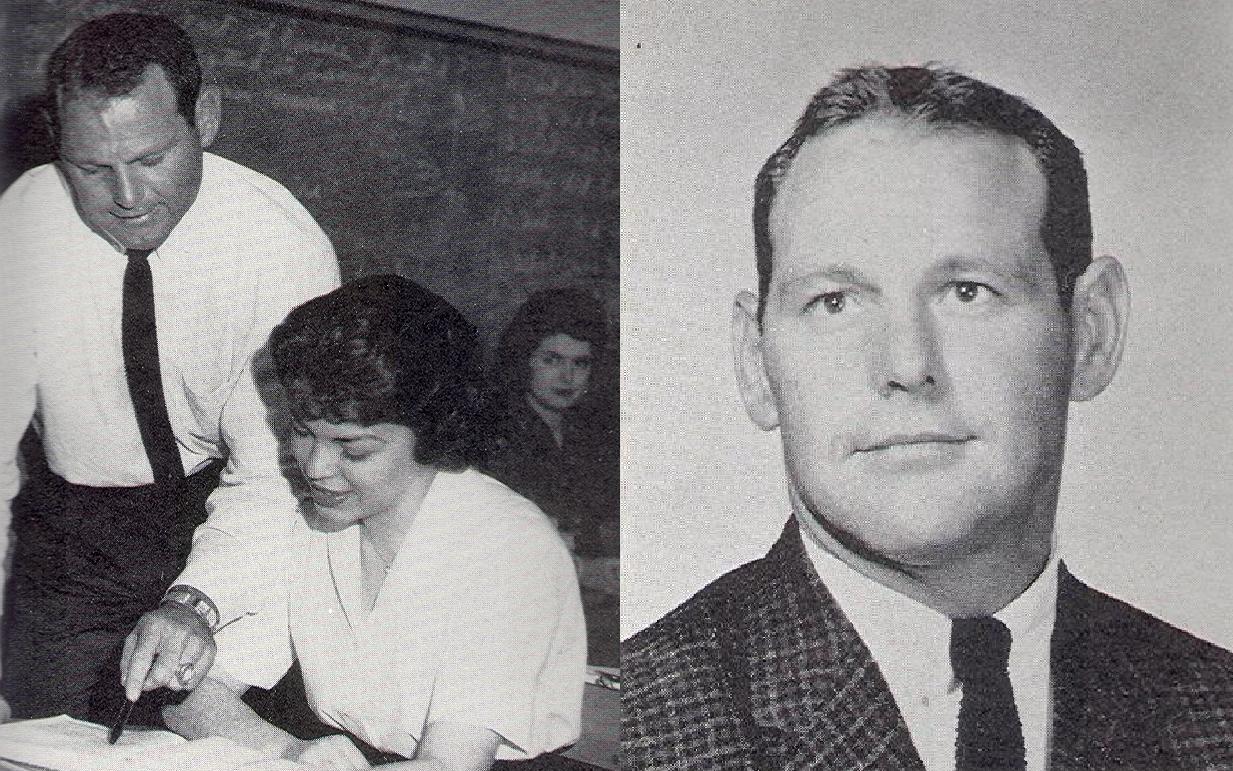
Charles Berry, Twain Morrow, and Bill Blocker

 
CJ64Mr. Charles Berry was the principal at Meadowbrook, and a fine one he was. He was an imposing man – tall with silver hair combed straight back with a high part, as was the custom in his youth during the 1930s. He had a flattened nose that could have only come from playing football without a face mask.

I never saw his written signature, but saw plenty of his stamped signatures. He always signed his name “Chas. M. Berry”, and it took me years to realize that the first part of the signature could be interpreted as “chasm”-- much like Al Kaline’s name is “alkaline”.

Mr. Berry’s philosophy in running a school was to pinpoint leaders from the student body and let them run the school with his guidance. The Student Council made a lot of decisions on the day-to-day problems of the school, and we felt we had a real voice in its operation. He also appealed to our finer natures, and it worked. For example, we might have been the only school in Fort Worth without locks on the lockers. He would always tell us that we were not that kind of school or that kind of people – we don’t steal from each other.

The result was a self-policed, safe school. Mr. Berry was the kind of man you didn’t want to disappoint.

He was later promoted to be the principal at Paschal High, and the promotion was well-deserved. Mr. Berry made a real difference in our lives.


The assistant principal and head coach of everything was Twain Morrow, who was naturally called “Too-Too-Twain” by the students. He was a reserved man who wasn’t necessarily likable, but did receive a lot of respect. He looked sort of like a more handsome Victor Mature with a straighter nose. He became our principal when Mr. Berry moved on, and the school transitioned with nary a hitch.


The assistant coach for everything was Bill Blocker, an emotional, outgoing sort of guy who tended to fat, had squinty eyes, a very upturned nose, and was naturally nicknamed “Piggy” (but never to his face!). Coach Blocker was a UT graduate and had been the manager and part-time player for the UT baseball national champions of 1950. He became the head coach in our 9th grade when Mr. Morrow took over as principal.

He was famous for giving out nicknames to his players. For example, Al Lewis became Alkali, Ted Moberg was Titty-rump, Roby Morris was Robo, I was “Johnny” (but I think because he couldn’t remember my name and probably thought it was Johnny), and so forth. When we were seniors at Eastern Hills, Al and Ted came out as co-captains for the coin toss against Poly High. The referee was none other than Coach Blocker, and he greeted them with “Alkali, Titty-rump, how you boys doin’?” -- much to the consternation of the Poly captains.

I played third-string center for him. In 9th grade I weighed about 120 pounds and was about 5’4”, and I wasn’t very fast or very good. Years later my wife and I went down to Austin to see Texas Tech play Texas. We checked into the old Alamo Hotel before the game and there in the lobby was Coach Blocker. By this time I was 6’2” and weighed about 185. I introduced myself, and very much to my surprise, he beamed and said “Johnny, you played center for me!” I was stunned that he could remember a very non-memorable player, but that is the kind of guy he was. Unfortunately, he died young not too many years after that from a heart attack.

To the boys, these three men were the heart and soul of Meadowbrook Junior High. We were fortunate to have men like that to help show us how to be men.


Thursday, May 31, 2012

Roy C. Johnson EHHS Principal


Would you have bought a used car from this man? Some of us would have taken whatever he might have offered under advisement in order to reserve judgment. I always thought this “trust me” picture pretty well illustrated Mr. Roy C. Johnson as some of us saw him.


Roy C. Johnson was the school’s first principal, so he had the job during the time the 63 Highlanders were assigned to the institution. Mr. Johnson had an expansive persona, a down-home Texan manner, and was an enthusiastic cheerleader at pep rallies. His daughter was a year younger than we were—a 64 Highlander. As I recall, she was considered by others to be a nice young lady, although I didn’t know her.

Some in our class didn’t care too much for Mr. Johnson. And even now I couldn’t articulate very well why that was so. Some thought that he was highly ambitious for a higher level district job and might have been a little too aggressive in his self promotion. One manifestation of that notion was that he hung a large, formal portrait of himself in the school’s front entry foyer. Flanking his large portrait, evenly spaced on either side were somewhat smaller (I think) portraits of the school board members, including the Superintendent. That might have been the job Mr. Johnson really wanted.

Someone took his portrait down one day, leaving the school board portraits undisturbed. For several days the portrait was missing and it was said that Mr. Johnson went ballistic when he made the discovery. The image of Captain Queeg’s search for the strawberries dances through my mind.   It was also said that Mr. Johnson had some “spies” among our class, but a lot of people knew who the spies were, so they weren’t much of a threat. Within a day or so, Mr. Johnson had all the other portraits taken down—thinking, I suppose, that if he couldn’t hang there, then by-golly no one else would hang there either!

After some time went by, Mr. Johnson’s portrait was returned to its place of honor in the front foyer, right in the center of a row of empty picture hangers spaced equally either side of it. However, that portrait was a bit different than it had been before its hiatus in service as a revered school treasure. Mr. Johnson’s image was inverted inside the frame. So, just turn it over, you might suggest. O.K., but first you would have to remove the youthful manifesto sheet that had been inserted in the frame, just in front of Mr. Johnson’s image. So, just take it apart and remove the sheet, you might suggest. O.K., but how would you suggest freeing up the super glue that held the mat assembly to both the glass and the frame?

I don’t recall if those portraits were re-hung in the front foyer before we graduated. However, I do seem to recall a certain probing look in Mr. Johnson’s eye as he extended his congratulatory hand to each us at our graduation ceremony. Danny McCoy always called Mr. Johnson, "Sugarbottom" and I never knew where that came from--just found it amusing.

Just ahead for some of us was Animal House.


(May 2014 note:  Discovered some time ago that "Sugarbottom" was the name of a very small town or area in North Texas somewhere, where Mr. Johnson grew up.  It hasn't existed for many years.)


Adios.

Thursday, May 10, 2012

Melvin Avery


“Probability is expectation founded upon partial knowledge. A perfect acquaintance with all the circumstances affecting the occurrence of an event would change expectation into certainty, and leave nether room nor demand for a theory of probabilities.” --George Boole


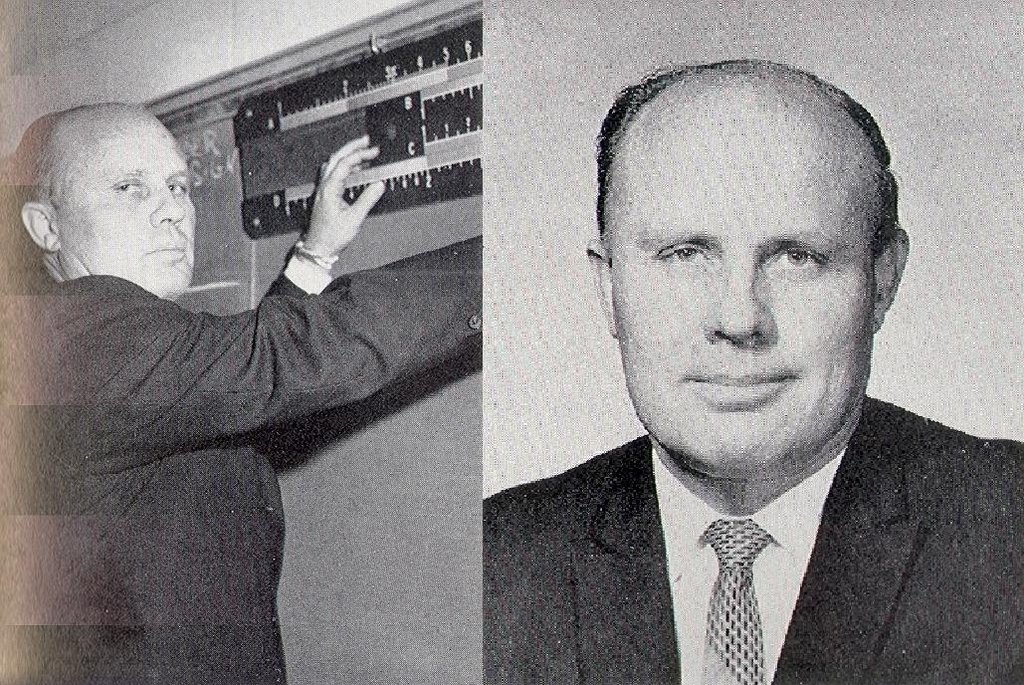
My vote for the next best 63 Highlanders teacher would be Melvin R. Avery. As with Mr. Sills, I have no particular anecdotal stories to tell of Mr. Avery. My regard for him is a result of a body of experience gained while studying mathematics (algebra, I think) in his class. Mr. Avery was not very tall, a roundish, quiet spoken teddy bear-type of man. What I really remember about him was his enthusiasm while presenting his subject. He was another one of those teachers who established a non-threatening classroom environment.

Mr. Avery was infinitely patient, although he could show some frustration when someone didn’t quite understand a concept he had just broached. However, he would quickly quell his impatience at those times and go over it again. I think his frustration was really less a matter of impatience with his students, than with himself that he had not gotten his point across clearly enough.

He exhibited several memorable traits, memorable enough that I recall them clearly now, after nearly 45-years. Mr. Avery loved number games and would frequently use them to demonstrate different approaches to problem solving. An almost boyish exuberance would overtake him as he introduced one of those number games to the class and he could become almost gleeful when one or more of his charges would take up the challenge.

This is a link to an online number game that Mr. Avery would have loved and it illustrates the kind of game he liked to introduce in his classes:


Although I recall a Jr. High math teacher, Mrs. Doris Fuller, who was very, very good in the subject, I'm sure it was Mr. Avery who ignited an early mathematics afterburner in many of us. I would credit Mr. Avery for introducing math more as a challenge than an ordeal.

Another thing I recall of him was that he loved sports although they were focus of neither his career nor his classes. I think one of the coaches adopted him as an unofficial assistant, gave him a leather-sleeved jacket, and included him on some of the team trips. There is a great picture of him in the ’62 Clan yearbook, page 105, that shows Mr. Avery proudly wearing his jacket, boarding a team bus.

His son, Ray, was a good athlete and the starting Center on our ’63 Highlander (’62 season) district championship football team. Ray resembled his father in that he was a quiet, good-humored, roundish kind of kid.

In the picture accompanying this posting, Mr. Avery is demonstrating how to use a slide rule. About a dozen years after that picture was taken, slide rules were relegated to the backs of desk drawers, and then to history almost overnight by the introduction of HP and TI calculators. It’s interesting to think that the design of our Interstate highway system, of the first jet aircraft, and probably much of our first ventures into space were produced using slide rule calculations.

I think Mr. Avery passed away about 1990 at age 71. He served in the United States Navy during WWII as a Seabee in the Pacific.  Thanks for your patience and for the help, Mr. Avery. . . . O.K., class. Quick, what is 5/6 divided by 2/3?


Adios

Saturday, May 05, 2012

Billy Sills


Most of us end up with no more than five or six people who remember us. Teachers have thousands of people who remember them for the rest of their lives." –Andy Rooney

My vote for the best 63 Highlander teacher is Billy West Sills. He was only 34 when he taught our senior classes and was a slight man who was always nicely dressed in a coat and tie. He exuded a quiet dignity and strength of character that enabled him to control his classrooms in a calm, competent manner. He was not a macho-type, but rather was a man who tended to command respect with a firmness that I don't recall as being threatening in any way. He had a thorough knowledge of his subjects which, as you might recall, were American History and Government.

I’m pretty sure I took every class Mr. Sills taught and I’m sure that my keen appreciation of history today traces directly back to his contributions to my education. I don’t have any specific anecdotal remembrances of Mr. Sills. My memory of him is more in the manner of a body of shared experience. After we graduated and went on, his career path took him to the ISD level as an administrator and later, I think, as the district historian. Just as Andy Rooney points out, Mr. Sills was very well regarded by a large population that he touched during his life. There are some FWISD facilities named after him. He died in 2002 at age 74. Men like Billy West Sills don’t come along very often and the world is a lesser place without him.

Mr. Sills walked with a very pronounced limp caused by polio.  No matter though. About the only way that limp inhibited Mr. Sills was to prohibit him from being a competitive sprinter. He was first cabin in every respect. God bless you, Mr. Sills, and thank you for all the help.

Adios.

Tuesday, May 01, 2012

Mr. Bill Polson


For some of us, Bill Polson was our 10th grade World History teacher. While I've taken pains to either ignore those about whom I have nothing good to say, Bill Polson is my first exception. That's not to imply that I have only bad things to say about him, it's more that I just have nothing good to say about him...yet he was an interesting character.

Mr. Polson was, in my estimation, the laziest teacher I recall throughout my schooling. He also had the job of keeping the locker assignments straight and dealing with lost or broken locks. After school, I think he drove a school bus. For Mr. Polson, teaching consisted of taking out his textbook and reading from it...verbatim. His delivery was a slow monotone drawl, the cadence broken only by his looking up occasionally to see who had nodded off.

Thankfully, he broke up the monotony of his class by having a couple of girls write the test questions on the chalk board a day or two before the Friday test...the every Friday test. Only girls did the chalk board writing and not always the same girls, but they were usually attractive.

Everyone in class had to copy those questions off onto their own papers in order to study them for the upcoming test which always consisted of those same questions, verbatim. It may never have occurred to Mr. Polson to mimeograph the questions onto a handout as was done by most other teachers; or it may have been something else. As I mentioned in another posting, girls of our day wore loose-fitting dresses similar to those worn by their mothers, so we boys had little opportunity to effectively appraise their figures.

However, an interesting thing occurred when the girls of that day wrote on the chalk boards. Due to some complicated principles of leverage (one of Newton's laws), the pressure exerted by her arm on the chalk board caused her backside to jut out in an equal and opposite direction and move in sync with her writing arm. So, if she were writing quickly, well the reactive movement going on under that dress was pretty quick also. Now, that made concentrating on writing those questions onto your paper somewhat difficult, but the weekly shows were memorable.

I wonder if Mr. Polson ever picked up on that...h-m-m.

Rounding out his week by having a couple of girls, always girls, grade the Friday tests and write the results in his grade book, Mr. Polson was set for a quiet weekend to repair himself for a couple of days of strenuous reading from his textbook the following week. As I said, he was an interesting character.


Dieu merci pour les jolies filles

Thursday, February 02, 2012

1967 - 1968 Johnson Out; Harris In


After spending a little time going through some of the old EHHS CLAN yearbooks that can be found online, an interesting story about the first changing of the old EHHS guard began to reveal itself.  Perhaps those of you who stayed close to the East Side knew of these changes, but for others of us who moved away after high school, it’s interesting to learn a bit of this old history.

It’s clear that the leisurely consistency of our trek through the East Side schools changed abruptly about 1968.  However, it appears that the Handley influence continued well into the 1970s.  Marvin Harris, a long serving administrator at Handley Jr. Hi, became EH’s second principal, fall 1967.  Lee Tannahill, another Handley teacher/administrator, took K.O. Vaughn’s Vice Principal job.  He was Chemistry teacher, Sara Tannahill’s husband and had been a long serving shop teacher and Vice Principal (I think) at Handley.

One of the underlying objectives of doing this blog has been to try and understand some of the more puzzling aspects of growing up in this particular East Side area.  As I’ve mentioned elsewhere, I recalled a number of competing influences that I as a newcomer to the area about 1958, never quite understood.  It would seem that these first administrative changes further demonstrated a strong Handley influence on early EH.
 
The accompanying pictures are a sampling of the faculty pages from a 1969 CLAN that show about 24 of the teachers we knew during our time there, were still teaching. 

About 1977-78 I returned to the school for a visit and found Coach Mitcham sitting at a desk in the middle of the office area, surrounded by construction debris.  They were apparently remodeling the offices and general layout.  He was one of the Vice Principals then and it was the first time in 15-years that I had seen him.  Our short meeting was a little bittersweet; I knew him, of course, but he had to search his mind a bit before he could recall me.  It was the first time I had had the experience of observing the fact that teachers, over the course of a long career, deal with so many youngsters, they can only remember certain ones.  He associated me with the team Roby had quarterbacked!  Roby again—still had my craw full of him.

K.O. and his paddle had nothing on the Coach.  Mitcham had his weapon out on his desk and was “seeing” a nearly constant stream of bad boys reporting for their punishments.  It was so extreme that we couldn’t carry on a quiet conversation without being constantly interrupted.  He suspended the afternoon sessions so we could talk.

There wasn’t much of the old school left, a few teachers and that was about it.  Mitcham looked weary.  We chatted for a few minutes in that way people who no longer share common interests, do.  It was the last time I saw him.  


Adios

Monday, January 30, 2012

First Coaches - George Mitcham, James Willingham, Dub Graves

During the time we attended EH, our experience was influenced by a number of different individuals…classmates, teachers, coaches, K.O. Vaughn, and Roy Johnson, conspicuous among them.  And for boys, certainly those participating in organized sports, perhaps the most memorable of those influences were the coaches.  They shaped the character of our teams and set the agenda for many, many hours and months of our lives.  And as described in my Dub Graves article, they could also contribute something of a vision for the future.

This brief essay chronicles the early history of the first EH varsity football coaching staff, including a few subtle changes, and ending with their eventual departure after the 1967 season.  Most of us had an experience with them that lasted only 1-3 years, then left for college or life, and never returned, or if we did, it was an infrequent visit to a school that no longer reflected the one we had known.

1959-60, Year 1.

Coach George Mitcham got the job as Eastern Hills’ first head coach.  Bill Ellliott joined him that first year as assistant coach as Eastern Hills competed in the 3A district that year.  Elliott had been Mitcham’s assistant at Handley High School for several years during the 1950s.  After this one season, Bill Elliott returned to Handley Junior High which was still in the same building as the former HHS.

1960-61, Year 2.

This was the first year that EHHS competed in 4A against Ft. Worth’s largest high schools.  Coach Mitcham was joined on the coaching staff by James L. Willingham as line coach and W.A. “Dub” Graves as backfield coach.

1961-62, Year 3.

No changes to the coaching staff this year.  Ronnie McBee, “B” Team coach leaves at the end of the school year.  He returns to EH in 1967,

1962-63, Year 4.

No changes to the coaching staff this year.  EH won its first 4A-5 District Championship.


1963-64, Year 5.

No changes to the coaching staff this year.

1964-65, Year 6.

No changes to the coaching staff this year.  The picture below is the only one I've found that shows the coaches in their typical attire while working each afternoon out on the practice fields.  A bunch of old duffers (about 35-39) that kept themselves in very good shape.


1965-66, Year 7.

No changes to the coaching staff this year.

1966-67, Year 8.

EHHS won its second District championship in 4A-5 this year and the season was the last one we would recognize as the same lineup of District opponents since the school first entered the City’s 4A league.

This was Coach Graves’ 7th and final season as an Eastern Hills coach.  Graves, 38, left the Ft. Worth ISD to work for a local credit union for the next 25-years. 

Roy C. Johnson, the first EH principal, left his post for another ISD assignment at the end of this year.

1967-68, Year 9.

This would be the last year Coach Mitcham and Coach Willingham served as EHHS “A” Team coaches.  Mitcham, 40, ended a 20-year coaching career to take a position as Vice Principal at one of the ISD’s other schools.  Willingham, 43, became the District’s Assistant Athletic Director.  Coach Ronnie McBee returned to the school in his previous position.

At the end of the school year, K.O. Vaughn, 55, retired after 30 years with the FWISD.  He had been the North Side band director for 16-years before becoming a Vice Principal at J.P. Elder Jr. High, then at EHHS.


Note, from a Wikipedia article:  "Dating back to 1910, the UIL only governed white schools in Texas.  From 1940 to 1970, an era of racial segregation in Texas, the Prairie View Interscholastic League (PVIL), headquartered at Prairie View A&M University, served as a separate parallel organization for African-American public high schools in Texas.

"In 1965, the UIL agreed to admit PVIL member schools for competition.  Black schools began UIL competition beginning in the 1967-68 school year. After the 1969-70 school year, the UIL fully absorbed all PVIL member schools, the majority of which would later be merged with their white counterparts."

1968-69, Year 10.


For those of us who were around for the 1962 season, the new additions to the coaching staff are nearly astounding.  Jerry Sadler was the Head Coach of the North Side team that handed us our only District loss that year...and Raymond Davila was his team's quarterback!  Davila was voted the District 4A-5 outstanding back for the 1962 season.  I think he played football at Baylor.

Hmm...Davila was our age.  Don't know about you, but in 1968 I was about 9000-miles west of Ft. Worth collecting combat pay...see how those various deferments worked?  In school--deferred; married--deferred; employed in a critical defense industry--deferred; Reserves--sort of deferred; Daddy with political connections--maybe Germany or an erstwhile journalist; with children--even more deferred, etc.

1968.  Gone are Johnson, Vaughn, Mitcham, Willingham, and Graves.  It was a different locker room, to be sure.

Adios

Tuesday, January 17, 2012

Dub Graves 1928 - 2012

Coach Graves left us last night
R.I.P. Dub
 

Was there ever anyone as cool as Dub Graves? With a build sporting a six-pack before some of us knew what to call it, Coach Graves was a tanned, muscular Adonis who moved about our hallways with us. Always in good humor, his attitude seemed to radiate the fact that he loved his job and his life.

And why not? Dub Graves turned 34 during our senior year and was still single, although he never seemed to lack for female company. Could anyone ever forget that fine ’56 or ’57 turquoise T-Bird convertible, often with a hot blonde seat cover? I have no idea where he lived, but I think it was on the West Side. During the summer he could sometimes be seen out on Eagle Mountain Lake working on both his wooden Chris-Craft, and on his tan. Those who saw him at our 20th reunion saw a white haired version of an older Adonis, still full of it.

As a coach, he was far and away the best athlete on the coaching staff. As a teacher of American History, I would have to venture a guess . . . not as good as Mr. Sills. Dub was also one of the P.E. teachers and if I were to venture another guess . . . he didn’t like that too much. I think he much preferred to coach the school’s athletic teams. To amuse himself during our senior year, he instituted the “Tough Tail” contest in his P.E. classes. This contest established an award of sorts, for the guy that took the most licks during a semester. I don’t know how long that went on, but was always surprised that it drew some active “competition” for the trophy.

Never did know what his "W" name was...Walter, maybe.  But his middle "A" name (Anath) was always visible.  However, I recall his stern warning that he would not tolerate any mispronunciation of that name.  You had to think a little about that one, but soon enough you realized that he most likely had some problems along the line with others mangling it into anus...wow, Walter Anus...no wonder he stepped around that one.

He taught me an effective way to block down field by launching myself into a safety's chest.  Coach Graves made it look easy, but for me it was a little more difficult...I didn't have the coiled springs in my legs he still had at age 33.  He did leave me with one of his little poems, one that I remember to this day.  I can't remember the cardinal dates in my family life, but I can remember that little ditty, word for word.  He made one up for each guy on that '62 Highlander team and read them at the season's end banquet.  How I would love to have the words to all or some of those little poems.  They were styled in the same manner as Cassius Clay, then the boxing champion, was using to promote his early career.  Clay later became Mohammad Ali, of course. 

During the 1950’s, Dub had flirted with a professional baseball career, and had been a varsity back with the University of Tulsa football team. He was a favorite of Principal Roy Johnson from some previous school district assignment they both held, I don’t know what jobs Dub held after we left, but by the time we held our 20th reunion in 1983, he was in public relations for the teacher’s credit union.  He was quite a character...an unforgettable one.


This is the turquoise color T-Bird I recall Coach Graves driving around EHHS.  My clearest memory is of him with a blonde alongside, pulled into the small low area between the shop doors and the tennis courts above.  Football players exited the locker room from a door in that same area and frequently saw Dub sitting there in his beautiful T-Bird, a great looking blonde by his side.  I think he married this girl sometime after we left EH…and another one bit the dust!  His obit mentions that he had been married 47-years.

I left EH an 18-year old with a broken heart—my first love, a flop.  Fortunately, 18-year old broken hearts are resilient and after reaching into whatever character reserve I then possessed, managed to recover. 

There’s really no way to credit anything or anyone specifically for whatever reserve one draws on to repair and adjust to ongoing life, but could there be any real question that Coach Graves had planted a vision in me and contributed something of himself to my recovery?  A couple of years after leaving EH with that broken heart, I had rounded up my own convertible and a blonde seat cover.

Thanks for the insight, Coach Graves…..and Thank you God!    


Friday, January 13, 2012

K. O. Vaughn & THE PADDLE


Someone wrote to ask why I had not yet done a piece on Kenneth O. Vaughn, the first EHHS Vice-Principal. I had a reason, but it was a little difficult to express because my thoughts of him involve a larger, more complex body of thought than just a few anecdotes and observations. The fact is, when I think of K.O. Vaughn, I’ve always recalled him as the “Enforcer.” He was the school’s disciplinarian, which in our time meant….THE PADDLE! And since corporal punishment in public schools has been a lively topic over the past decades I’ve thought it worth a rational treatment.

Mr. Vaughn was a skinny, relatively tall Ichabod Crane-type of guy; energetic, always jovial, neither quiet nor boisterous. He roamed the halls with a smile on his face, but behind that cheery smile many of us knew that he was really, “the enforcer.” As the enforcer, he was the academic teachers’ go-to-guy when they had a discipline problem with someone. In my recollection few, if any, academic teachers wielded a paddle themselves…Mr. Vaughn took care of that for them. You knew that behind that mousy or meek female or male teacher, lurked the possibility of a trip to Mr. Vaughn’s office and in short order, a stinging backside.

As the pictures accurately portray, Ken Vaughn never quite managed to find a suit that fit very well, so although he was a neat and clean sort, he always had a bit of a frumpy look to him…at least to my eyes. However, you can credit him for handling a job that appears to be currently employing 6 or 8 people to accomplish similar duties at a school that still has about the same number of students. To my knowledge his boss Roy Johnson, didn’t directly involve himself with discipline matters.

One of Mr. Vaughn’s regular tasks was to patrol the student parking lot to ensure that no one left campus without having a proper pass. Get caught without a pass…the PADDLE! He also patrolled the hallways during a school assembly in the auditorium to ensure no one ducked out of a remote doorway to go play pool, instead. Get caught ducking out…the PADDLE! And during lunch periods he would patrol the few local food joints to snare anyone away from school without a lunch pass. Get caught eating away from campus without a lunch pass…the PADDLE! You get the idea. I think he was also the de facto school truant officer which gave him more opportunities to swing the PADDLE!

Ken Vaughn coached the tennis team during the spring so, it was said that he had a good swing. He was an accomplished musician who had some kind of connection with the Carswell AFB band which visited the school to perform once or twice each year.

As it was at Meadowbrook Junior High, the male coaches at EHHS handled their own discipline matters, which were almost an ongoing event, especially in the PE classes. At the Junior High, the shop teachers were notorious enforcers, but at EH, I think they weren’t quite so active. To understand the inconspicuous role the PADDLE played in our public school matriculation, you would almost have had to have been there. In my own experience, it was a constant threat from the first day of the 7th grade until graduation 6-years later.

Of the coaches, only Ron McBee and Dub Graves were enthusiastic wielders of the PADDLE. Both of them were mostly employed as PE teachers, each of them having a full day of classes, so there was an ample supply of potential miscreants. The other coaches, George Mitcham and James Willingham would swing a paddle now and then, but neither of them were nearly as prolific as McBee and Graves. Mitcham looked after study halls each day and Willingham taught American History.

Members of the school athletic teams could be targets, but not very often and never for trivial reasons as could be the case in the PE classes. However, of the 6-licks I got over my 6-years in the risk zone, 3 of them came from Coach Willingham…and I was completely innocent! It was Phil Nixon’s fault and I never really forgave him.

While in the showers after football practice one afternoon, Phil thought it would be funny to throw a wet towel at Coach Willingham, and so he did. The towel, heavy with water, hit Willingham in the back of his head with a resounding splat and nearly knocked him over, ass over tea kettle. Willingham, an easy going sort, slowly turned around with a wide, exasperated grin on his face and asked who did it? None of the 8 or 10 guys in the shower replied, including Phil, the culprit. O.K., says Willingham…3 each. And Phil never said a word, nor did anyone else. It wasn’t so much that we wanted to protect Phil as it was a kind of adolescent camaraderie where we just wouldn’t give up a team mate. We did get a towel for cover, but it didn’t help any and for the record, Willingham didn’t swing very hard.

An 8th grade shop teacher delivered my first fiery tap…talking, as usual. And K.O. tapped me twice for some trivial offense reported by James Ledbetter, our resident EH Aggie. Can’t say I learned anything from those assaults, other than to be more careful about getting caught doing trivial stuff and that in my particular case, public officialdom was 50% flat wrong and only marginally right another 35% of the time. That 8th grade shop teacher nailed me fair and square.

After we left EH and during the tumult of the sixties that included the Civil Rights movement, the Women’s Rights movement, and Vietnam, the issue of school paddlings came to the fore of public discourse. It was only one of a number of anachronisms in our society. Our generation reasonably asked that if we were old enough to be called to war at age 18, why weren’t we old enough to have a beer in the local pub? Similarly and more pointedly, the same reasoning was applied to the voting age…we could be forced by the draft to go far away to kill and be killed, but we could not vote on those responsible for taking us into the war—both the voting age and the drinking age then was 21.

All those anachronisms were addressed and changed—if there is one substantial thing our generation contributed to improving conditions within our society, I would nominate that it was us who firmly pressed our elders and authorities with the question WHY? It was a reasonable question to which there was often no rational answer.

Men like K.O. Vaughn represented the last gasp of a dying institution … beating or threatening to beat our children into submission. I recognize that comment is a bit harsh and not really representative of the type of man K. O. Vaughn was. He and the others highlighted in this piece were all good-humored men, also fair and credible contributors to our secondary education. Smacking young fannies was an ancillary activity in their daily routines and probably of marginal effect in dispensing discipline. However, as the historian, Shelby Foote, liked to say (paraphrased), “there is nothing so conducive to maintaining a polite society than the threat of a punch in the nose.” Perhaps it’s the absence of the threat of a tap on the rear that has, in part, led to the sad state of affairs in our public schools today.


K.O. Vaughn retired in 1968 and his departure was appropriately marked with the dedication of that year's CLAN...


Either that same year, or the year before, Roy Johnson, Coaches George Mitcham, and James Willingham, also left EH. Coach Graves left in 1966 to work for a local Credit Union, where he stayed for 25-years. Many of the teachers we knew during our years there were also gone; after 1968 the school was substantially different than the one we knew. Many of us were starting our families, trying to hang on to those coveted II-S draft deferments, or for some of us, an all-expense paid trip to Southeast Asia was our award following receipt of a snail mail message from our local draft board.


Adios

Monday, November 07, 2011

Meadowbrook Elementary School Grades 1 - 6 1951-57


Most of the kids shown in these pictures would be members of the EHHS Class of 1963.

There was a 3rd third, fourth, fifth and sixth grade class--do you have one of the missing pictures?  Need 4th grade pictures...teachers were Mrs. Nail and Mrs. Flemming.

NOTE:  The large 2nd grade class sizes were ~25% smaller the next year for 3rd grade.  Was another (3rd) class added?  (YES, Mrs. Schulz)  Have you got one of the 3rd class pictures?  Burton's in them...don't know who else...maybe Sam.

Similar class pictures from EHHS Class of 1962 & 1964 also sought.


Adios

Friday, July 29, 2011

Meadowbrook Coach Bill Blocker

Anyone who attended Meadowbrook Jr. Hi. in the 1950s and later would recall Coach Blocker, a fixture in the PE department. His cousin was Dan Blocker, Hoss Cartwright in the TV series, Bonanza. Blocker was an expansive figure who had played baseball and/or managed with the 1950 UT National Baseball Championship team. I knew him as the assistant coach of the Meadowbrook football teams where he tagged me with a nickname I was never quite able to shake off. Some of you were still calling me that nickname when we graduated, 5-years after my first encounter with Blocker. Not sure what that says about our relative influences. 

Memories of Blocker from a ('64): CJ64-The assistant coach for everything was Bill Blocker, an emotional, outgoing sort of guy who tended to fat, had squinty eyes, a very upturned nose, and was naturally nicknamed “Piggy” (but never to his face!). Coach Blocker was a UT graduate and had been the manager and part-time player for the UT baseball national champions of 1950. He became the head coach in our 9th grade when Mr. Morrow took over as principal.

He was famous for giving out nicknames to his players. For example, Al Lewis became Alkali, Ted Moberg was Titty-rump, Roby Morris was Robo, I was “Johnny” (but I think because he couldn’t remember my name and probably thought it was Johnny), and so forth. When we were seniors at Eastern Hills, Al and Ted came out as co-captains for the coin toss against Poly High. The referee was none other than Coach Blocker, and he greeted them with “Alkali, Titty-rump, how you boys doin’?” -- much to the consternation of the Poly captains.

I played third-string center for him. In 9th grade I weighed about 120 pounds and was about 5’4”, and I wasn’t very fast or very good. Years later my wife and I went down to Austin to see Texas Tech play Texas. We checked into the old Alamo Hotel before the game and there in the lobby was Coach Blocker. By this time I was 6’2” and weighed about 185. I introduced myself, and very much to my surprise, he beamed and said “Johnny, you played center for me!” I was stunned that he could remember a very non-memorable player, but that is the kind of guy he was. Unfortunately, he died young not too many years after that from a heart attack.

The Target back to school ad below is a pretty good illustration of how I recall Coach Blocker...a kind of drill sergeant in PE whites. He was a conspicuous figure and yes, we climbed that damned rope to the top of the gym ceiling, maybe 30-ft up, a lot. Little, strong guys like Glen Brandon were best at it...for bigger guys it was tougher--more to haul up there..


Adios


Tuesday, July 12, 2011

Charlotte Ballard – Polly Lovett – Ruth Priddy—English

Bruce McDonald shared with me that he recalled his EHHS English teachers as being remarkably good; they were, Mrs. Dyer, Mrs. Smith, and Mrs. Priddy.

That got me to thinking about my own lineup of English teachers, only one of whom I shared with Bruce—Mrs. Ruth Priddy. I must admit that English classes and English teachers were not my favorites. Although I did pretty well in the classes, I always seemed to struggle a bit more in them than in other subjects. Not until much later in life did the art of sentence and thought construction begin to interest me. And while banging out some words isn’t much of a chore these days, I still tend to get things out of order sometimes.

My first English teacher was a fearsome vision, Lillie B. Stokes, at Richland Jr. Mrs. Stokes was also my homeroom teacher so, I got a double dose of her daily, for a year. I don’t recall much about her class, but I clearly recall her admonition on opening day of 7th grade: “If you cannot behave yourselves, we will try to reason with you at this end (pointing to her head), and if that doesn’t work, we will go to work on the other end.”

Now, while I’m pleased to report that she never found a reason, to “reason” with my other end, I just don’t recall much about her class. Mrs. Stokes was of my grandparents’ generation, born about 1894, and was a stark example of how that earlier generation viewed dealing with miscreant children. I don’t know how it was in other 7th grades around the area, but I do recall no fewer than 4 other teachers in my school threatening to bust my butt or the butts of others during that first year in Jr. Hi. I think I’ll deal with that topic in a separate posting.

At Meadowbrook, English for me, meant Mrs. Jane Sheets. I don’t have a picture of her, but clearly recall her as a slight woman with a constantly dour expression on her face. I don’t recall feeling particularly threatened by her, but there were a number of other teachers at Meadowbrook who did represent an potentially painful threat to many young East Side butts; coaches Bill Blocker, Twain Morrow, and shop teachers, Creel Phillips, and a Wayne? Hampton, all stood ready to dispense summary retribution. As for Mrs. Sheets’ classes, about all I recall of them was a seemingly endless struggle to correctly diagram sentences which didn’t make a lot of sense to me at the time.

At EHHS, English for me meant Mrs. Ballard, Mrs. Lovett, and Mrs. Priddy. By that time I had learned that negotiating for higher grades was possible…except for Mrs. Ballard and Mrs. Priddy, both of whom were quite rigid. Mrs. Ballard was a little gruff, where Mrs. Priddy was one of those seemingly nice ladies who would butcher my work with a smile on her face. Had a couple of those in college also and never did really understand their game. Math and science was more my thing.

My favorite of the 3 EHHS teachers was Mrs. Polly Lovett who was not only a very nice lady, she was also negotiable. Bless her heart. I do wish I had been a better student, or at least had gained a better appreciation of the effective use of the English language at an earlier age.

My 1st grade Ohio teacher, Miss Matilda Saunders is shown at right…doesn’t she look like one of the Our Gang teachers, except Miss Crabtree, of course. Miss Saunders was at least as old as Mrs. Stokes, a circa 1894 woman, maybe even older. She was as stern as she looks in this picture, but she was also very patient and good enough as a 1st grade teacher to get me off to a good start. When I came to Texas for 2nd grade, the Dallas school suggested to my parents that I skip 2nd and go directly into the 3rd grade. My parents wisely declined, thinking that I would do better over the long haul by sticking with my own age group through school. They were right.

Adios, seriously!

Tuesday, May 24, 2011

First Faculty – Eastern Hills High School – 1961

The pictures were scanned from a 1961 CLAN yearbook and were the only formal portraits taken of the teaching staff while we were at EHHS. In subsequent years the teachers’ pictures were candid shots that significantly varied in quality. Although a 1960 CLAN might show a slight difference in faculty composition, it would most likely be a relatively trivial variance.

When we graduated in 1963, the teaching staff had changed somewhat and the count was up to 46 from the 36 pictured here. The listing below was scanned from a 1961-62 Student Directory.

The school was undergoing rapid growth as the Baby Boomers entered their high school years. Graduate count went from 145 in 1960 to 410 in 1965.


Adios