
Mr. Scott helped organize the league, recruited the players, arranged the uniforms, found the practice and game venues, coached the practices, and coached the games. He did all this while supporting his family as a pilot for Central Airlines. He was a physically impressive man – at least six feet, 200+ pounds with very wide shoulders, huge chest, and muscular legs and arms. He was balding and kept his blondish hair very short so that from a distance his head looked shaved. His face featured a strong jaw, long sculptured nose, and piercing eyes. He grew up in upstate New York so he had no drawl, but enunciated each word and delivered them with an authoritative baritone voice. When not flying or coaching, you could see him in the parks or at the school grounds exercising – stretching, pushups, side-straddle hops, and running; and all this in an era when nobody exercised.
Like almost all the fathers he was a WWII veteran. He had been a Navy pilot (his grandfather had been a Navy Captain, and his great-grandfather an Admiral). Before Pearl Harbor he had been a football player at Cornell in an era when Cornell was a national power. He was born in February, 1922, so he would probably have been a 19-year old sophomore at Cornell when the war broke out. For most of the war he was a transport pilot in the Pacific, probably flying the R4D (the Navy designation for the DC-3) or perhaps the PBY Catalina.
As a coach, Mr. Scott emphasized exercises, fundamentals, and drills. The exercise started the practice and featured jumping jacks (up/downs), side-straddle hops, pushups, and sit-ups, and “six-inches”, where you lay on your back and lifted your legs, legs straight and feet together, six inches off the turf (if you like sore stomach muscles, try this one). Fundamentals: he would show you how to block, or tackle, in great detail, then make you practice in one-on-one or three-on-three situations. If you didn’t do it correctly, he would stop the drill and show you again how to do it correctly. Drills: he would set up a defense and set up and offense, then explain the play to the offense using a diagram detailing blocking assignments, fakes, hand-offs, receiving routes, and so forth. We would then walk through the play in slow motion. When he thought we knew what we were doing, we would run the play, over and over. He would do this with five or six plays, early in the season. After that, he assumed we could execute what was diagrammed on any play and we would just run what he showed us. If we screwed up, he would do a walkthrough, and run it until he thought we had it right.

Oddly enough, I don’t recall any instructions on defense or special teams, other than what position you should be in. For example, on defense, since I was a center on offense, I played middle guard (a/k/a nose tackle) in the 5-4 and middle linebacker in the 6-3. So, basically, in the 5-4, the offensive line played the same positions and tackled instead of blocked. I think the defensive backs (the uncounted 2 in the 5-4) knew they were supposed to worry about the ends, but that is about as complicated as it got. On kickoffs, we knew when receiving to peel back then block like hell; when kicking we knew to run like hell to the ball carrier, and never let him get around the end. On punts, we put 2 backs on the wings, and 1 next to the punter, and I had to deep-snap it. That’s about as sophisticated as we got.
The offense we ran in elementary school was the Cornell single-wing, and it was a gas. It was like the wildcat or spread formation of today, but much more sophisticated in its backfield execution. Below is a basic play, the 41-Able power sweep:
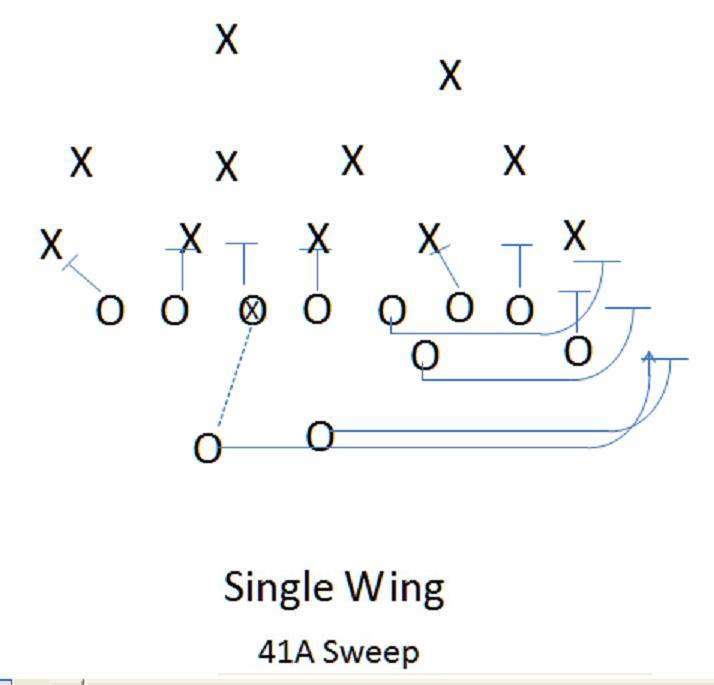
It’s a simple play – the tailback (number 4)
receives a direct snap and goes right, led by the fullback. Everybody who can pulls and takes out the
first available defender. The formation
always used an unbalanced line, in this case strong right. Another basic play was the fullback spinner,
where the fullback takes the snap, spins counter-clockwise, fakes to the
tailback sweeping right, and plunges into the line between the inside and
outside guards. This formation was used
extensively in the 1920s, 30s, and 40s, but was dropped in favor of the T
formation because coaches found it too hard to recruit a tailback who could
both run and pass effectively. Nowadays,
every high school and college seems to have two players who can run and pass,
and maybe it’s time for a comeback of the single wing.
Later on, Mr. Scott converted to the Fly-T, the offense run by Tommy Boswell. The QB is under center, fakes a dive play to the FB (the technique was known as the “belly series”), and pitches to the sweeping Fly back (tailback). The other option is to hand off to the FB, and fake the pitch. Every other play was a variant of this basic play.
.jpg)
Mr. Scott’s approach to the games was everybody got to play at some point. He organized us into units that practiced and played together. I have forgotten what he called us, but it was something like Green, White, and Gold, and we did notice that Green got to play most of the game, but we also thought they had earned it. We played both ways when in the game.
By the time we reached 8th grade, many of us had been playing for Mr. Scott for 3-4 years. We had enormous respect for him. He was no-nonsense, firm, fair, and honorable. By the 8th grade, he had expanded the reach of his program to include players from Meadowbrook, Handley, and Riverside junior highs. We were known as the East Side Eagles. We wore white helmets and white pants, and green jerseys. Our regular opponents included the Panther Boys Club, the TCU Tiny Mites, and the Ridglea Roughnecks. We always won more than we lost. Some of the notable players in the program were Bob Larmer, Steve Means, Sam Scott, Tom Koebernick, Bob Ladd, Mike Cooper, Bill Gilmore, Tommy Boswell, Randy Blake, Ward Ericson, Tommy Thompson, Roy Burklow, and Kenny Allen (all EHHS graduates); and Gary Cantrell (Poly QB and West Point punter) and Jimmy Long (Carter QB).


