Monday, April 30, 2012

Ft. Worth East Side Evolution - 6 - Eastern Hills High School


Our EHHS Class of 1963 was the second EH class to have attended all 3 years at the new school.  Although we may not have attached much significance to that fact at the time, the fact that a class had attended all 3 years at EH meant that essentially none of the students in that class knew any other high school experience.  That was a significant difference from the first 2 EHHS graduating classes, 1960 & 1961.  Before EHHS opened in 1959, members of each of those first classes had attended either Poly or Handley High schools as underclassmen.

For those of us attending EHHS as underclassmen during those first couple of years, what appeared to be a stable atmosphere was actually something much different.  The school was growing and changing substantially from one year to the next.  The first (1960) EHHS graduating class was essentially the Handley HS juniors from that school’s last year.  As such, members of that class were and remained very close to one another over the years.  Although there may have been a few Poly transfers, there were not many.  Poly seniors living in the Meadowbrook area were given their choice of schools, EHHS or Poly, to finish out their high school matriculation.  Not surprisingly, most of them chose to finish at Poly.

The 1961 class was more of a mix from the 2 other high schools, and the 1962 class was the first to have attended EHHS all 3 years.  For the reasons of these mixes and changes, attempting to write a generalized description of our East Side high school experience is difficult…it was quite variable, depending on which class is the focus. 

Our music charts were most frequently topped by Ray Charles and Roy OrbisonElvis and the Do-Wop melodies of a few years earlier were giving way to the Isley Brothers' “Twist and Shout.”  About the time we prepared to leave EH, the Beach Boys and the Beatles burst on the music scene.  Our music was changing quickly.

Our popular films were the beach blanket bingo films of the early sixties…Frankie & Annette and Gidget & Moondoggie.  Didn’t we all wish we could go out to California and play on the beach, just like in those movies?  …some of us did!  There were some memorable dramatic films also…the “Days of Wine and Roses” produced a theme song of the same name, which we tried to vote as our senior class song.  After her filibuster of the motion, Miss O’Dell vetoed that one.
 
For our very own pop culture icons, we had Audrey Hepburn, Brigitte Bardot, Jackie Kennedy, AND James Bond.  Has there been a more amazing group of attractive people since those?

Audrey may have been the icon for those a little older than us, but did you ever see another woman wear a black dress any more strikingly than her?  

And if we needed another beautiful image for our early maturing years, could there have been a more classy person than Jacqueline Bouvier Kennedy in our White House?

And although JFK was a handsome man, you have to agree with me…for us, the symbol of urbane sophistication was James Bond, right?  Weren't we all challenged to emulate this guy, if we could?


Brigitte was our new sex symbol following Marilyn who held that spotlight during our 1950s childhood.  To see Brigitte though, we had to go to one of the West Side theaters where she could be seen in some non-descript film…but only if you could bluff yourself by the “adults only” restriction at the door. 

Since about the 6th grade, we were encouraged toward the study of math and science…a reaction to Sputnik getting into space before the USA.  For most of our Jr. Hi. and high school years, the NASA space program occupied prominent places in our daily ingestion of the news.

During our fall 1962 senior semester, the Cuban Missile Crisis played out in the Atlantic and in the Gulf of Mexico.  On October 22, 1962, the United States military services were placed on DEFCON 2, the highest post-WWII alert status our country has ever been on.  And the country remained on DEFCON 2 until November 15, 1962.  During those few weeks, our Highlanders played football games against Carter Riverside, Paschal (yes, the famous 8-7 win!), Poly, and North Side, winning 3 of those 4 games!

So, with so much going on during those years leading to our departure from EHHS in 1963, it is really difficult to characterize us in general terms.  We had a variety of external influences moving us toward adulthood, including the flaming monk phenomena that was building far to the west in Southeast Asia.


Road Trip !
 

Saturday, April 28, 2012

Yes, Dear - Plus 2-Years


Well, it's been 2-years since I tried to die. Feeling fine now, thank you.
Wife continues to amaze me. She's still watching some of those cooking programs and sees more things she would like to add to her kitchen tools. We still don't have space for them unless she throws something out.  Wife is a packrat - she throws nothing out; chaos seems to suit her.  Oh well, we'll find some more space.

 Last Year

 This Year 

Got her one of those nice organizers this past year...you know, one of those things with the compartments for separating things...it's under there, somewhere.  And the beat goes on...


Adios

Sunday, April 15, 2012

Driver’s License Renewal – The Examiner


Over the span of your first few license renewals you learn that as long as you don’t allow your current license to expire, the renewal is fairly painless and does not involve a driving test…and another go at the dreaded “parallel park” maneuver.  Even when renewing in a new state, you find that most states observe reciprocity with one another.  Usually, there’s no written test either…as long as your current license has not expired.

However, let your license expire and it’s a do it all over again situation…written and driving.  About 14-years after getting my first license as an EH sophomore, for whatever reasons involving a move to a new state, I let mine expire.  So, here we go again, the whole enchilada. 

We grew up in a segregated South where, when we first got our license, all highway troopers were Caucasian-Americans.  Fourteen-years later, that was no longer so.  Entering the written test area I notice a dude, similar to the one pictured, sitting on a stool, acting as the test proctor. 

Since I’ve got to take a driving test after the written, I had to write the description of the car I would be using for the test on their test form.  At that time I was driving one of those fast little foreign sports jobs that was the dream of every adolescent boy and unattached young man.  Its color and accessories screamed, “up yours” even when sitting still.

While I’m taking the written test, I notice the trooper casually scanning the papers, including the test car description.  The trooper gets up from his stool and steps over to one of his side-kicks for a short conference, referencing my papers.  Shortly, my trooper disappears, replaced by his side-kick, who takes over the proctor perch on the stool.

Grading the written test was quick, and within a few moments I’m outside for the driving test, wheeling my “up yours” car around to the starting line, a long CB antenna whipping in the air.  There’s my missing trooper dude, standing on the starting line, waiting for me, clipboard in hand.  A cool, pretty day…the top is off.

Somewhere I had read that the only limits required to be met during the driving test was to not drive recklessly and stay within the speed limit, and of course, meet all the other rules regarding stopping, yielding, and whatever else.  Reckless was defined as chirping the tires loose.  I reason that accelerating to the speed limit is at my discretion and turning corners can be done as quickly as I can turn them, as long as the tires don’t break loose—what’s to be concerned about?  I’ve been driving for 14-years, after all. 

Making sure my trooper is buckled up, off we go, going fast, turning fast, and stopping fast...but never chirping the tires.  Slamming around the surrounding neighborhoods, the loud, distinctive exhaust blasts its notes, and double clutching the gears up and down fills the air with a fairly consistent, tightly-wound, loud engine noise.  There are 5-gears on the floor, but only 2 are used for this test...we aren't going very fast, even though it sounds like we are.  Although my trooper is armed with a clipboard and test check list, he doesn’t mark on it…he’s engaged for most of the test in hanging onto his hat with one hand, and holding onto the chicken handle with the other.  He’s grinning, ear-to-ear and I think he waived the dreaded “parallel park.”

Back at the DPS shop, still grinning, he dismounts and says, “you handle it very well.”  Thanks, I say…it’s the third one and I’ve had plenty of practice.  Don’t recall another driving test since, but this one was a kick.


Zoom 

Friday, April 13, 2012

Driver’s License Renewal – The Gatekeeper


Got my license renewed yesterday.  It’s been 51-years since I passed that first fearful “parallel park” maneuver.  Although technology has changed radically over the past half-century, the periodic trip to DMV remains remarkably static…it’s often been a miserable event. Miserable clerks to blame, I think.

I’ve had licenses in about a half-dozen different states and all of them are similar…guess that’s not surprising since driving is similar in those various places, too.  Four wheels, a steering wheel, some signs, some lights, all about the same.  Except Colorado…there they want to be sure you know that it doesn’t take as much beer to make you dizzy, so they focus on a few tricky altitude-related questions. 

Years ago, in large cities, the lines and resulting wait could drag on for hours and sometimes result in finding that due to having overlooked some obscure sign in a huge room, you had been standing in the wrong line.  And seeking any sympathy from the mind-numbed clerks is fruitless anywhere.

Yesterday, I accompanied my eldest to get our renewals done.  Living in a small town helps avoid long lines, but nothing whatsoever improves the encounter with the ill-tempered, scowling Gatekeeper.  She looked very similar to the lady pictured above and she was absolutely impervious to my sexagenarian’s wit and charm.  Nothing worked…not quips, not winks, nothing.  Don’t recall her name…I’m sure it wasn’t Kristin or Misty.

Got my license, though…an 8-year deal, no restrictions.  If I’m still alive for the next renewal, I’ll be 75.  Eldest steps up to the unsmiling Broom-Hilda, smiles at her, compliments her Grinch pen, and the hag smiles back!  And she keeps smiling throughout Eldest’s gymnastics with the forms and pictures, even letting her check the picture result.  For goodness sake! 


Beep-beep

Wednesday, April 11, 2012

Navigating this Blog


  • Topics are written as they come to mind and published in chronological order.
  • Multi-part topics are generally posted in sequential order and grouped together.  As they are published, they show up in reverse order in the archive list (see side-bar).
  • The Google search window works just the way its net search window does, but limits its search only to the blog.
  • Labels located at the end of each piece will find and return links to all other posts having that same label.  This is a very good tool for quickly locating similar material.  (Unfortunately, it depends on me to put the labels in, which I sometimes forget—so, it’s not perfect, nor am I).
  • Tip 1:  If you return to Google’s net search window and search for 1963 ehhs much of what is returned points to this blog. 
  • Tip 2:  Switch the Tip 1 returns view to “images” and nearly every image you see points to this blog.  This is a very easy way to skip around the blog to things you want to see without having to plod through the archives.

Tuesday, April 10, 2012

Jim’s Ditching Story


            This is an abbreviated version of a much longer story I thought I would share as an illustration of the kind of useful information transfer that can take place online.  Before the arrival of the net, developing something like this was essentially impossible.  For instance, until many of the WWII veterans started retiring in the 1980s, most of them knew very little about the larger story they had once been a part of during the war.  My father, a 21-year old aviator in 1944, built a substantial WWII library and for most of his life, studied the Army Air Force he had been a part of. 

            The wide availability of the net arrived a little late for most of them, but many invested a huge amount of time and effort in further recording their experiences as young men.  Their communication tools:  a phone, mail, and Xerox copies of original documents.

            Jim never flew with my father’s crew although they did fly their missions during some of the same months of 1944, from the same Army Air Force base in England.  A few years ago, as I went through my father’s things, I found the beginnings of Jim’s story.  It was a 1-½ page typewritten letter and a few pictures Jim, then 70, sent to my father as his submittal for possible use in the Group’s reunion history.  Jim’s story wasn’t used; he passed away a year later.

            His brief letter didn’t contain much information, but as I read it I could sense the pride and strength in the once young eagle’s words.  He included a photocopy of his Goldfish Club patch and certificate, which suggested that there might be an interesting story beyond Jim’s words.  I dug into it.

            Here is Jim’s 1991 letter as he wrote it:

A Mission Remembered


“One of the most memorable of the thirty missions as a ball turret gunner was my sixth with the Squadron and the sixty third for the Group.

            “May 12, 1944 was to be a day not easily forgotten.  Our mission was to destroy a parts and repair plant, the Focke Wulf, in Swickau, Germany.

            “Early in our flight we were met with heavy German resistance.  In spite of the loss of one engine due to heavy enemy fire and flack, we were able to continue and deliver the bombs right on target.

            “Returning back to the base was a bit more challenging.  Two more engines were made useless by the constant German fire and flack.  The injured tail gunner managed to down one enemy plane and I downed two from the ball turret.  On orders we’re going to abandon ship.  Within a split second our plans were changed when the injured waist gunner accidentally kicked out another chute as he jumped.  It was decided that we would ditch in the English Channel.

            “As the plane lost altitude, everything of weight was thrown out (guns, ammo, radio), anything to make her lighter.  The plane took quite a beating.  We now had a B-17 with one engine and a flack ridden bomb bay door which could not be completely closed, heading for the channel.  The crew had a fatally hit tail gunner and a severely wounded navigator.  Under the skilled hands of Lt. William Moses, the plane skimmed the choppy waters and an unbelievable landing was made.

            “Our surprise of surprises came as those red handles were pulled and only one dinghy was found put aboard.  I have since learned that a stripe or two was lost due to the oversight).

            “The deceased tail gunner was buried with the fast sinking plane as the others got into the dinghy.  The dying navigator knew I was the only crew member on the outside of the raft, hanging on rather tight.  He asked the co-pilot that he be buried at sea thereby making room for one more, me.  Upon his death, his wish was sadly carried out and I was helped on board.

            “The sight of an English sea plane coming to our rescue made us more aware of being attacked by ground troops.  We were closer to the French boarder than first thought.  The rescue plane took two rough hits but we safely boarded and headed out.

            “After being released from the English hospital, where flack was removed and treatment was given, a week of R&R at Spetchley Park was quite a welcome change.  Then it was back to the base from where the remaining missions were flown.

            “Before leaving for the U.S., I was presented with a patch and a card making me a member of the Gold Fish Club.  On the way home I truly felt exactly what belonging to the “Lucky Bastard’s Club” made me. . .

            “Upon graduating in Larado from gunnery instructors school, it was on to Westover Field, Massachusetts.  Assignment at the Range ended about the time of V.J. Day.  Honorably discharged at Ft. Devens, I headed for Toledo with a new “Ruptured Duck” and a promise that was fulfilled six months later when a New England gal became my wife.  Looking back there is no doubt, I had the privilege to fly with a great crew that day.  As anyone reading this has experienced…some days were a bit easier than others but it’s great that I’m here to write this and that you are here to read it.  So it surely was a good cause after all…God bless America.           

Jim - 1991
                                                                       

                    Jim’s letter was puzzling in that he didn’t name any members of his crew.  A bomber crew was typically a very tight-knit unit, but in Jim’s case, as I discovered later, he was flying as a replacement with this crew…so, he didn’t know any of the others.  He had a story he wanted to tell, but it was really hard to figure out from his letter just what it was.  This is not uncommon when you read old accounts, or more recent accounts written by older men…we all tend to lose our sharp recollections over time.  However, I recognized the specialized terminology from having studied my father’s AAF service.

            There are so many similar stories that time doesn't permit developing them unless they touch my father’s experience.  Jim’s halting story intrigued me.  Within a few hours online, I had the names of the crew and a very narrow idea of what had occurred.  Within a couple of weeks I had the Missing Air Crew Report from Maxwell AFB and a much better understanding of the story.  Of the 10-man crew, 7 had been rescued, 2 killed, 1 bailed out and taken prisoner; and the rescue planes had come under fire from the shore about 4000-yards distant.  This was a far more dramatic event than most similar ditchings with which I was familiar.

            After taking the story as far as I could in 2007, I wrote up a brief piece summarizing the information I had, and posted an inquiry to one of the WWII Air Force forums.  Almost 4-years passed before the first response came in.  It was Jim’s daughter and she knew less than I did about her father’s ditching experience, except that it had happened.

            About a year later, after 5-years had passed, a great nephew of the “deceased tail gunner” and the pilot’s son got involved by comparing their notes and pictures.  The MACR contained a real collection of documents that included reports from nearby aircraft, from a German POW camp, and from several of the rescued crewmen themselves.

            Jim’s crew had been seriously shot up over the target, torn up further by Luftwaffe fighter attacks on the way out, and ultimately they ditched just offshore.  Unlike most ditched aircraft where the crew was killed, 7 of Jim’s crew managed to survive the ditching and escape capture aboard a rescue plane as it came under fire from the nearby shore.  As a result of the "deceased tail gunner's" distraught father being very persistent in seeking the details of his son’s death, the MACR was filled with far more information than are most others.  There are lengthy personal letters from several crewmen describing what had happened in much more detail than Jim wrote in 1991.
           
            Quite a bit more could be developed about these crews and this particular mission.  For instance, other researchers are working on the details of the mission itself and of individual unit locations.  It is known that the Luftwaffe fighters had repeatedly attacked Jim’s bomber stream in their devastating 10-abreast frontal attacks.  At this point in the war, these attacks were rare--the Luftwaffe had been severely damaged earlier in the year during "Big Week."

            The following is a page from Don’s personal journal describing Jim’s May 12, 1944, mission from Don's perspective flying in a nearby B-17…it was found quite by chance as I was preparing this essay.  These are his words, verbatim, as he wrote them into his journal after returning to base from the mission…it’s poignant to think that as he was writing these words, Jim and what was left of his crew were just being recovered from the English Channel:

 “We started out this morning at 8 O’clock, flying our own ship (400) as #5 in the lead.  Our route was between Dunkirk and Ostend.  A little way in enemy territory, we picked up a few of our escort (P47’s).  Then about half-way to the target, bombardier calls out about 10 e/a which attacked from 12:30 high.  They passed thru us not making any hits, or us on them either.  P47’s jumped, leaving us without dropping bombs on us (no effects seen) and attacked following wing.  That wing was lit up like a Christmas tree with 20 mm cannon fire.  I saw at least 10-12 B-17’s blow up or else go down out of control.  It was a horrible sight.  About 5 minutes later about 15 e/a passed thru our formation, causing one ship in high group to blow up, and a few other planes to feather props.  This was another head-on attack.  From then on to the target we were not bothered by e/a, but were also without visible fighter support.  Our bombs were dropped over primary target O.K., and from what I could see results were not good.  However, the other group really plastered the aircraft plant.  There was no flak there, but during the day we ran into scattered stuff, none of it accurate.  After the target, we picked up some P-38’s which “S” –ed overhead.  At that time we were attacked by 12 ME 109’s from 1 O’clock, a little high.  The escort didn’t seem to pay a bit of attention to them, which burned us up.  From then on the rest of the mission was without incident.  Our crew made no claims on e/a, and I saw only one fighter go down.  Peters (co-pilot) and Prendergast (navigator) flew with us, otherwise complete crew.  Flying time was 8 hrs. about 6 ½ on oxygen.  No damage to our ship.

            This was a helluva mission, and made me admire those old timers that flew without escort (note: just a few months earlier in 1943).  The Luftwaffe still packs a mighty wallop, if they want to come up and fight.  On visual missions, like today, we are going to see a lot more of ‘em. (Hope not!!!)”
 
            Most recently, and most astoundingly, one of the current descendents researching this story of his great uncle (the deceased tail gunner), found on eBay a picture of a lone B-17 shown in a large, but clear Army photograph.  He bought it knowing only from its markings, that the plane is from his great uncle’s Group.  He sent a copy of it to me after he received it.


             I was able to isolate the plane and enlarge the clear image.  The tail number identifies the aircraft as being Jim’s plane !   And the lower border nomenclature reveals that the mission is the one that Jim’s story tells.  You can clearly see smoke trailing from the off-side, outboard (#4) engine, #3 appears to be feathered, and there is visible damage on the horizontal stabilizer.  As related in the accounts, this plane was shot to hell.

            They were still aloft, by themselves at this point, in slow descent heading for their date with destiny.  And this is a fantastic story that began with a single posting to the net, about 5-years ago.  None of the survivors ever saw this picture...the story now belongs to their descendents.


Do you see any tears in my eyes?

Monday, April 09, 2012

Digisexual - Dilbert


Been laughing so hard the past few days my sides are hurting...and along comes Dilbert with this gem.

Almost done with a serious post, once I can beat through the writer's block I've had with it.  Maybe up later today, or tomorrow.

G'day

Monday, April 02, 2012

Nabisco Round Saltine Crackers


It’s an oxymoron, isn’t it?  Noticed about a week ago that my life-long saltine cracker maker, NABISCO, had changed its package…nothing new there—see my earlier rants in the blog about the toilet paper makers jerking around with their packaging.  This ongoing jiggering with packaging, flavors, and weights irritates me on other levels, but this one is a direct attack on one of our fundamental, life-long preferences.

Of course, one of the principal reasons for the change is to confuse consumers so they will pay more for less product…a quasi-clever way to raise prices—significantly.  That’s going on across the board with all manufacturers and is made ever simpler since the advent of EXCEL spreadsheet programs.  The problem with those programs is that they are only good at if-then-else calculations, and utterly clueless with regard to whether a considered change will enrage their customers, or not.  I suppose it's the marketing department’s job to make that calculus, and you know what I generally think about unbridled marketing.  But then, I’m just a Dilbert-type technical guy.  I suspect there are a few of my kind muttering quietly to themselves somewhere back in the dark, hot, and greasy parts of some NABISCO plants.

In a world where airlines that once ran their operations without much drama, we now observe those operations run by today’s current crop of managers having serious problems figuring out how to get passengers off a stranded airplane at the gate…for 7-hours!  And now we have the Giant Kraft Foods, owner of NABISCO since about 2000, under the leadership of the ladies shown above, apparently seeing no problem trashing an American standard we have known all our lives.

Time will tell how this works out for them, but for now the house brand saltines at half the price are just fine by me.  One thing those spreadsheet programs cannot calculate is the effect of my dropping OREOs, Maxwell House, and pretty much anything “NABISCO” from my shopping rotation.  With the problems today’s “enlightened” management teams" seem to be having running their “core” businesses, I doubt they will ever figure out what went wrong and why.  But then again, few of them stick around long enough to care much about that anyway.

I may address flavored salt next.

Dec. 2012 Update:  Apparently our dissatisfaction with this ham-fisted maneuver has had some effect.  I've got a much larger selection of my old standards back on the shelf.  But take notice my NABISCO friends, those "house" brand saltines are just as good as yours and at half the price.  Now you've got to get to work and re-sell your product to me.  And I've generally dropped most of your products from my shopping list.  This particular move on your part was disgusting in my mind....or, maybe just dumb !

BTW, this article is one of the most heavily visited pages in this blog.

Adios 

Saturday, March 31, 2012

Men & Women & Reunions


I picked up this piece somewhere online and found it amusing.  It was written by someone much younger than us, so I cleaned the language up a little.  Perhaps you will enjoy it as I did.

“As we get older, men realize that women are always changing (their minds, their outfits, their stance on fooling around, etc).  Before this happens though, we think the girls are the most confusing puzzles in the world.  I’ve always thought that if I was a kid and knew half of what I know now, I would have made a serious killing with the ladies.  Same thing goes for this: if I’d had this categorization of girls when I was a kid, I would have fathered at least five accidental children by now.  Check out our list of stereotypical high school girls below.

The Hottest Girl in SchoolThis girl was hot, and I mean smoking hot.  Sure, you are a little older and realize looks aren’t everything (but she's still at least a '7.5' though).  As you go up to talk to her at that welcome back party your buddy has over the summer, that nerdy kid who used to do the announcements comes up with two drinks.  "Thanks, babe," she replies.

Yes, the world can be a cruel place.

The SleeperRemember that girl who you went to high school with?  Of course not!  You never had a class together, she wasn’t the best looking, and despised the people who smoked pot, so you were overlooked by her.

But now years later, you've reconnected… She’s actually pretty cool!  And you stand a good chance because she doesn't actually know you that well.

The Ex-GirlfriendYour ex was super hot in high school.  Well, at least you thought so.  But now that college and the freshman fifteen have entered the game, you begin to doubt your original opinions.  Sure, it might seem like she's gaining a pound every time you check her Facebook.  In reality, that's just her stock getting older and generally depreciating in value.  Thanks, societal norms!

The Old Fling.  You log onto Facebook, and your old fling seems to have found and added you.  The last time you saw her was freshman year of high school, hell, maybe even 8th grade.  She has a kid now?  What the f***?!?!?!  Boy time flies when you don’t check up on people.

Your Best Friend.  She was always there for you in High School  Oh yeah, she also really, really wanted to get you in the sack.  You threw her into the friend zone because... Actually, you can't remember why.

Now that nobody's sleeping with you, even she turns you down.  Life is tough. Just keep being nice and maybe she'll come around.

The Nerdy, Quiet One.  You know that company you want an internship with?  Well, that nerdy quiet girl you ignored your whole life just now happens to be the person interviewing you.

How did she get so good at promotions and social media?  She was never even at a single one of your parties.

The Overlooked One.  This girl went under the radar.  You (kinda) know who I'm talking about: sort of friends in high school, but that’s about it.  Friendly hellos in the hallway if you caught awkward eyes ever.

Never in a million years would you have thought that she would have been so gorgeous.  Maybe you should call her, and set up lunch or something.  Oh wait, no.  It's too late.

The One Who Didn't Like Boys.  It took you all those years to figure it out?”


Adios

Sunday, February 26, 2012

Mr. Scott & Pee Wee Football

cj64-Pee Wee football was an organized league of boys’ football teams run outside the school system.   In the Meadowbrook-Handley area, the founder and coach was Sam Scott.  Mr. Scott’s son, also Sam Scott, was class of ’63, and played for his father in elementary school.  By Junior High he was too big to play as there was a not-to-exceed weight limit for the Pee Wee league for age about 12 and up.

Mr. Scott helped organize the league, recruited the players, arranged the uniforms, found the practice and game venues, coached the practices, and coached the games.  He did all this while supporting his family as a pilot for Central Airlines.  He was a physically impressive man – at least six feet, 200+ pounds with very wide shoulders, huge chest, and muscular legs and arms.  He was balding and kept his blondish hair very short so that from a distance his head looked shaved.  His face featured a strong jaw, long sculptured nose, and piercing eyes.  He grew up in upstate New York so he had no drawl, but enunciated each word and delivered them with an authoritative baritone voice.  When not flying or coaching, you could see him in the parks or at the school grounds exercising – stretching, pushups, side-straddle hops, and running; and all this in an era when nobody exercised.

Like almost all the fathers he was a WWII veteran.  He had been a Navy pilot (his grandfather had been a Navy Captain, and his great-grandfather an Admiral).  Before Pearl Harbor he had been a football player at Cornell in an era when Cornell was a national power.  He was born in February, 1922, so he would probably have been a 19-year old sophomore at Cornell when the war broke out.  For most of the war he was a transport pilot in the Pacific, probably flying the R4D (the Navy designation for the DC-3) or perhaps the PBY Catalina.

As a coach, Mr. Scott emphasized exercises, fundamentals, and drills.  The exercise started the practice and featured jumping jacks (up/downs), side-straddle hops, pushups, and sit-ups, and “six-inches”, where you lay on your back and lifted your legs, legs straight and feet together, six inches off the turf (if you like sore stomach muscles, try this one).  Fundamentals: he would show you how to block, or tackle, in great detail, then make you practice in one-on-one or three-on-three situations.  If you didn’t do it correctly, he would stop the drill and show you again how to do it correctly.  Drills:  he would set up a defense and set up and offense, then explain the play to the offense using a diagram detailing blocking assignments, fakes, hand-offs, receiving routes, and so forth.  We would then walk through the play in slow motion.  When he thought we knew what we were doing, we would run the play, over and over.  He would do this with five or six plays, early in the season.  After that, he assumed we could execute what was diagrammed on any play and we would just run what he showed us.  If we screwed up, he would do a walkthrough, and run it until he thought we had it right.


Oddly enough, I don’t recall any instructions on defense or special teams, other than what position you should be in.  For example, on defense, since I was a center on offense, I played middle guard (a/k/a nose tackle) in the 5-4 and middle linebacker in the 6-3.  So, basically, in the 5-4, the offensive line played the same positions and tackled instead of blocked.  I think the defensive backs (the uncounted 2 in the 5-4) knew they were supposed to worry about the ends, but that is about as complicated as it got.  On kickoffs, we knew when receiving to peel back then block like hell; when kicking we knew to run like hell to the ball carrier, and never let him get around the end.  On punts, we put 2 backs on the wings, and 1 next to the punter, and I had to deep-snap it.  That’s about as sophisticated as we got.

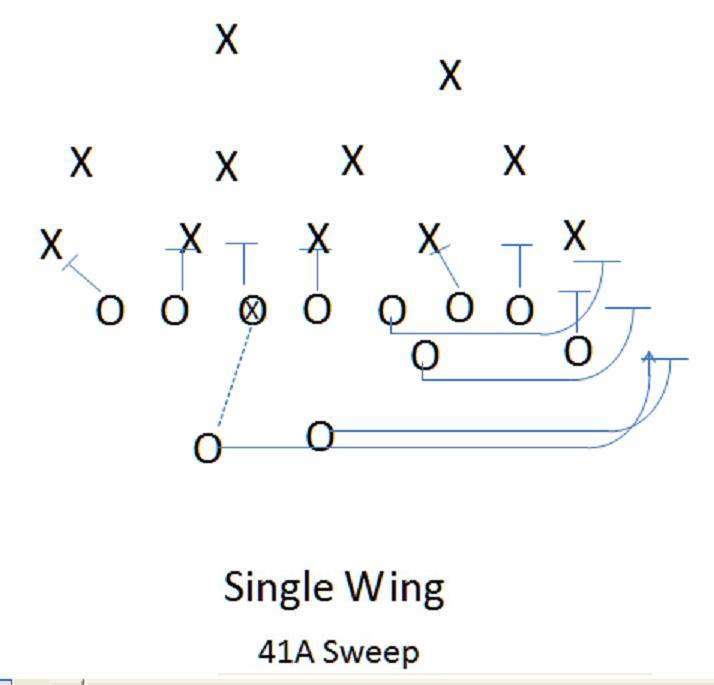
The offense we ran in elementary school was the Cornell single-wing, and it was a gas.  It was like the wildcat or spread formation of today, but much more sophisticated in its backfield execution.  Below is a basic play, the 41-Able power sweep:


It’s a simple play – the tailback (number 4) receives a direct snap and goes right, led by the fullback.  Everybody who can pulls and takes out the first available defender.  The formation always used an unbalanced line, in this case strong right.  Another basic play was the fullback spinner, where the fullback takes the snap, spins counter-clockwise, fakes to the tailback sweeping right, and plunges into the line between the inside and outside guards.  This formation was used extensively in the 1920s, 30s, and 40s, but was dropped in favor of the T formation because coaches found it too hard to recruit a tailback who could both run and pass effectively.  Nowadays, every high school and college seems to have two players who can run and pass, and maybe it’s time for a comeback of the single wing.

Later on, Mr. Scott converted to the Fly-T, the offense run by Tommy Boswell.  The QB is under center, fakes a dive play to the FB (the technique was known as the “belly series”), and pitches to the sweeping Fly back (tailback).  The other option is to hand off to the FB, and fake the pitch.  Every other play was a variant of this basic play.

Mr. Scott’s approach to the games was everybody got to play at some point.  He organized us into units that practiced and played together.  I have forgotten what he called us, but it was something like Green, White, and Gold, and we did notice that Green got to play most of the game, but we also thought they had earned it.  We played both ways when in the game.

By the time we reached 8th grade, many of us had been playing for Mr. Scott for 3-4 years.  We had enormous respect for him.  He was no-nonsense, firm, fair, and honorable.  By the 8th grade, he had expanded the reach of his program to include players from Meadowbrook, Handley, and Riverside junior highs.  We were known as the East Side Eagles.  We wore white helmets and white pants, and green jerseys.  Our regular opponents included the Panther Boys Club, the TCU Tiny Mites, and the Ridglea Roughnecks.  We always won more than we lost.  Some of the notable players in the program were Bob Larmer, Steve Means, Sam Scott, Tom Koebernick, Bob Ladd, Mike Cooper, Bill Gilmore, Tommy Boswell, Randy Blake, Ward Ericson, Tommy Thompson, Roy Burklow,  and Kenny Allen (all EHHS graduates); and Gary Cantrell (Poly QB and West Point punter) and Jimmy Long (Carter QB).


Monday, February 20, 2012

Wednesday, February 15, 2012

Ft. Worth East Side Evolution - 5 - Handley High School


Gus note:  The following memories were posted to the HHS Class of 1959 reunion site and are published here with permission.  Handley High contributed a significant element to our early experience at EHHS.  In fact, one long-term East Side correspondent reported that there was a strong contingent that favored naming EH, Handley High School but was opposed by a stronger Meadowbrook contingent not favoring use of that name for the new school.  Knowing something about HHS is useful in the exploration of our East Side experience.  Further note that we have been able to identify all of the '59s pictured on the front steps of HHS.  There are even a few EHHS '60s on those steps.   Ann White's dad did not take the picture.

HHS Memories

By Richard Clark

     HELLO 1959 GREYHOUNDS!  Do you remember giving Mr. Avery a hairpiece in class, and he actually wore it.  What fun!  One of the things that impressed me the most about our HHS education was the professionalism of our senior English teacher, Miss Odell.  Thanks to her I was able to write well enough to pass college classes.  Thank You, Miss Odell, for teaching us to write a term paper properly.  Do you remember memorizing a hundred lines of poetry?  What I remember the most about her was how she taught us Shakespeare.  I think it was MACBETH or something like that (maybe you remember exactly what it was), and she would quote a passage from memory, turn around, walk to her desk, and about 30 seconds later the bell would ring to end class.  She was some teacher; really, more like a college professor.  She inspired me toward a teaching career.

     Do you remember all the times we dressed up formally to go to Band and Football banquets?  I was always afraid of trying to pin the corsage on a girl’s formal.  I remember the time after our junior banquet when a group of us went together out to the “then new” Amon G. Carter Airport, looked around, and then went to David Grammar’s house for a get together.  Does anybody have a picture of that?  Seems like we did take a group picture.  Actually, the group picture is in our annual.  Kaye Buckellew was my date that year.  I remember showing off by buzzing the school while everyone was in class in my blue ‘53 Chevy with the loud twin exhaust pipes.

     Remember how we used to gather out on the front steps in the mornings before school started and catch up on the latest gossip and how your best girlfriend wore your letter jacket and your senior ring around her neck.  I remember how Coach Mitcham had us do head-on tackle practice, and I was always afraid that I would have to tackle Milton Strange.  Also, do you remember the time Coach made us run 1200 yards of wind sprints in practice?  I wanted to be on our A Team and just wasn’t big enough and had to settle for the B team.  How special the PEP Rallies were as Bunkie, Beverly, Marilyn, Jimmy, Kenneth, and Jack led the cheers while Coach Elliot gave the most inspirational pep-talks you have ever heard in your life, and the band played the “Handley Blues” with all of those special solos.

     Remember all of our Senior Activities?  I remember asking Rae Beebe to go to the Senior Banquet at the Colonial Country Club, and she had lain out all day by her new swimming pool receiving the worst possible sunburn.  She didn’t have a very good time at our Senior Prom because of that sunburn.  Remember going to Rae’s house for our ring turning ceremony under the arch at the garden party.  That is when I fell in love with Marsha leading to our marriage in 1962.


School Days

By David McConnell

     The bell rings and we each have five minutes to get from where we are to the next class. We might be in the gym completing a 50-minute PE class when the bell rings. If the next class is physics and our locker is on the second floor then we must hustle to get to the locker, change books, and make our way to the class on the third floor while maneuvering among a very crowded hallway. It was possible to do even while meeting a girlfriend at her locker for a brief encounter or while thumping a friend on his shoulder while passing in route.

     I think if we had the opportunity to go back to Handley High and to walk the halls, we might be surprised at how small the place actually was. Let’s see. The building had three stories and faced west. There was an auditorium on the south side and a gymnasium on the north side. On the east side of the main building, first floor level was the lunchroom. We had to make a line down the hallway to wait our turn to be served.

     To the east of the lunchroom was a paved tennis court area and to the north of it was the area that had courts for both tennis and basketball. A few temporary classroom buildings were north of the gymnasium and a baseball field lay just beyond them. The football field was detached from the main school ground about a block north and west of the main school.


     Some of us walked to school. Some of us drove our cars to school. Some of us rode the bus to school. Mostly we arrived early so we could visit with our friends. Some of us sat together on the front steps and talked while others walked down to the corner toward East Lancaster and had a smoke.

     I do recall spending lots of time socializing with friends. It’s very difficult to extract from my memory just where all of the time devoted to socializing came from that I’m recalling. It very well may be that my mind is playing tricks on me by amplifying the pleasant things and diminishing the unpleasant. In my mind, the class times have small diameters while the 5-minute social time between classes seemed, as I look back on it, to last all day.

     Somehow in all of the activities: the social, the academic, the sports, the running between classes, the friendships, the football games, the pep rallies, the working as office assistants, the lunchroom times, the study halls, the band practice, the cheerleading, the future teacher club, the future nurses club, the chorus, the National Honor Society (oops, sorry about that, I guess that wasn’t one of my activities); somehow in all of these things we managed to get educated. For the most part we had good teachers; even excellent teachers.

     Handley High School was a place that, for me, will always be treasured. The friends that I had there, though the demands of life have placed at a distance, will always remain a central part of who I am. I’m very confident that we each took more from Handley High than superficial thought would grant. Most of us took far more than knowledge. I believe we took character with us as we left Handley High. I’m confident that many of my classmates went on to distinction after graduating. Most of us are now retired and have the luxury of reflecting back upon the past and having the time to renew old acquaintances. That is what I’m looking forward to as the time of our 50th reunion approaches.

     What did you take away from Handley High? I’ll bet you took away many of the same kinds of things that I took away.  For most of us, we may not have long remembered the quadratic formula, the indicative mood, the date the Magna Charta was signed, the chemical formula for sulfuric acid, or even whether the numerator is the one on top or the one on bottom. We did, however, learn how to learn. This is probably the more important thing to take away. I’m certain that we learned that, and that our time at Handley High was a large factor in our learning such an important thing. We owe our teachers a debt of gratitude for that which they gave us.

     P. S. Leaving this on a lighter note, I should confess that I took away something that you probably didn’t take. After the school building was torn down, I went back and claimed two bricks from the school to make into two bookends as a keepsake from Handley High School. I still have them.


"How Things Were" 

by Linda (Wheeler) Duncan

     I only went to Handley for two years, but did I ever learn a lot.  I had come from a school that only had 10 or 12 classmates.  Boy!  To have 80 something in the class; well, I thought I would never remember who everybody was.  The groups had already formed with their own members.  Fitting in wasn't easy.  I guess I coped by being a little dumb and not paying much attention, but going merrily on my way--then I met Jamey the next year, my senior year.  We dated that year and were married a year after graduation.  It will be 48 years come the 5th of August since we married.  We are looking forward to all of the activities involved in preparing for this reunion.

     [David's note:  I really know how Linda felt, when I got there it seemed as though all of the girls were already spoken for (just as well, I would have been much too timid anyway); but, back to Linda.  Linda was a great person back then, one of the nicest I knew.  I was back in Fort Worth after being gone many years and stopped by to say hello.  I'm not sure that I had time to say a single word before getting a great big hug--now that's my idea of a wonderful person, one that I'm truly glad to have known, and one that I still count as a very dear friend.  People don't really change very much as far as virtues.  What you see in Linda now, her very endearing qualities, are those she always had.  For many of us, I fear, we were so self-absorbed that we (me as much as anyone) failed to fully see and appreciate the beautiful people all around us.]


Adios

Monday, February 13, 2012

Ft. Worth East Side Evolution – 4 – Poly


NOTE: The following is an excerpt from the memoir, Ink in the Blood, by Phil Vinson (Poly ’58), published in 2005 byVirtualBookWorm.com Publishing Co., College Station, Texas.

A friend of mine shared these words recently and graciously agreed to my republishing them here.  A number of our older siblings graduated from Poly and most of the Meadowbrook students attended Poly before EHHS opened in 1959. 

You couldn’t live in Fort Worth’s East Side without being keenly aware of Polytechnic High.  Each section of town in those days had its own high school, and each school seemed... to carry the reputation of that neighborhood on its shoulders.  Of course sports – and especially football – stood at the center of the community’s sense of self-worth. Poly had produced some excellent football and basketball teams over the years; many exes had gone on to prominent college and even professional careers.  But Poly stood for more than just sports; it was at the center of East Side culture, also having produced students who made names for themselves in journalism, politics, business, and the fine arts.

Poly drew from three junior highs: William James, Forest Oak, and Meadowbrook. Students came from virtually every white neighborhood east and south of downtown.  It was a big school, with an enrollment that had swelled to around 2,000 in the postwar years.  After some dreary years at Meadowbrook Junior High, I looked forward to attending Poly with great excitement.  I wouldn’t be disappointed.

ALMOST FROM THE FIRST DAY, there was a special feeling about Poly.  Teachers and students seemed friendlier.  The “hoods” of junior high seemed more in the background and were perhaps intimidated by the crush of older boys who could keep them in check.

Classes crackled with excitement.  Now the course material seemed to have a direction and purpose. The whole school seemed to be brimming with good humor.

Our first day in P.E. class, Coach Dan Campbell announced:

“Boys, there’ll be a towel fee of one dollar.”
“Whoooooo!” came the shout from a boy in back.
“Don’t holler,” said Campbell. “Just bring me a dollar.”
The boys roared with laughter, and Campbell joined in.

I had decided against taking any more wood or metal shop, but I still had an elective to take, and I chose mechanical drawing.  I felt that I could surely learn more about drafting than I had gotten at Meadowbrook.  Mr. Bales, the mechanical drawing teacher, gave us a sense of purpose.

“Boys,” he said. “Our government is in a space race, as you may have heard.  We can’t get a rocket off the ground, and the Russians are getting ahead of us.  We need some sharp, well-trained engineers and scientists.  Drafting is part of that process, so I’m going to hold you to extremely high standards.  Don’t let me catch you goofing off in here.  We’re going to learn to draft, the right way.”

In English, Gertrude Golladay assigned the class Beowulf to read. The students grumbled and moaned about the difficulty of Old English, yet Miss Golladay made the story interesting with her dry sense of humor.  Instead of scolding us for our lack of interest, she seemed to sympathize with our struggles.  You felt she was on your side as she guided you through the thicket.

Kelly B. Adair was about sixty years old and we heard he had retired as a mathematician from the General Dynamics aircraft factory.  Now he taught algebra at Poly, and I’m certain he knew his subject inside out.  But his communication skills left something to be desired.  He mumbled.

Mr. Adair would explain an equation, often with his hand in front of his mouth as he wrote out the problem on the board.

“Now, we see hrr tht the integr is X. The nnmmm sshers frnklm by the ridmmnn is the prdcsh of mmssmm times shrnnnbl. Got that?”

I fell further and further behind in algebra.

Martha Rawdon had been teaching biology at Poly for twenty-five years. Yet she never betrayed a waning interest in the subject.  She attacked biology with a passion and made sure everyone understood what she was saying.

She had a habit of saying everything twice, in fact, in a rapid-fire delivery that made it fun to listen to her. She’d draw out the word the first time, then spit it out emphatically the second.

“This is a pro-o-o-tozoa. A protozoa.”
“The protozoa lives in po-o-o-nd scum. Pond scum.”

Naturally the quirks of our teachers gave my friends and me plenty to talk and laugh about outside class.  We were having a good time but also learning.  How novel.

THOUGH I HAD A CYNICAL SIDE, 0perhaps the result of being around journalists such as my father, I’ve always been something of a sucker for appeals to sentiment. That was certainly so in my first year of high school.

Pep rallies, for example.  We’d had them at Meadowbrook, but they were rather sad affairs.  There was no band; only a teacher plunking out the fight song on a piano.

But Poly was something else.  By any measure, Poly had the best high school band in the city, not only in size, but in playing ability.  The band director, Frank D. Kasko, was legendary for drinking and lechery but also for his hard-driving perfectionism with the band.  Being in the “Marching 100” carried almost as much weight in the community as being on an athletic team.  

Pep rallies began with a scaled-down version of the marching band playing on stage in the auditorium as students filed in.  The music filled the hallways, and your spirits lifted just walking to the auditorium.  The band played classic marches – “Stars and Stripes Forever,” “Washington Post March,” “Entry of the Gladiators,” “Under the Double Eagle,” and “The St. Louis Blues March.”  And they played them well.

Then the cheerleaders took over.  The boys in the crowd mostly sat on their hands through the cheers, but the girls raised the roof with their yells, accompanied by throbbing drums in the band.

We’ve got the coach (clap, clap)
We’ve got the team (clap, clap)
We’ve got the pep (clap, clap)
We’ve got the steam (clap, clap)
Coach (clap), team (clap), pep (clap), steam (clap).
Go-o-o-o-o Poly.

MOST SCHOOL MASCOTS are lions, tigers, bears, eagles, yellow jackets, steers, etc.  Someone early in Poly’s history figured out what naturally went best with Poly – Parrots.  Poly want a cracker?

And our school colors: orange and black. Halloween Parrots.

After a number of cheers came the high point of the pep rally.  The band played “The Poly Blues.”  Frank Kasko knew how to work a crowd.

The tune was a simple blues but featured trumpet, trombone, and clarinet solos, then ended with a “shout chorus” by the whole band.  The cheerleaders did a modified jitterbug to the tune, and the students clapped and swayed with the music.  The tune always ended with a huge roar from the crowd.

After the “Blues,” Coach Campbell took the stage and made a few comments about the upcoming football game. It usually went something like:

“North Side has a real fine football team. I know our boys appreciate all this real fine support.  I think we have a real good football team this year, so y’all come on out and cheer ‘em on.”

THEN THE COACH WOULD CALL a couple of players out of the audience. They would stammer and mumble:

“We got a real tough game tonight, so y’all come on out and support us.”
As they left the stage, the band would break into the fight song, which had been appropriated from the University of Southern California:

Fight on for Poly High
Our team fight on
To victory....

While rock ‘n’ roll now dominated teenage tastes, it wasn’t all there was.  Radio stations played a mix of rock and “pop” music, and the public still bought records by Frank Sinatra, Nat “King” Cole, Jo Stafford, and Patti Page.  Movie and Broadway show music also found its way into the Top 40, and that fall of 1955, the film “Picnic” produced a No. 1 hit.

The rhythm girls did a dance routine to “Moonglow and the Theme from Picnic” that was among the sexiest things I’d ever seen.  Of course it didn’t take much in those days.  My friends and I never missed a chance to sit in the auditorium as the leggy dancers rehearsed this number over and over.

After football season that fall came the semi-annual production of the Poly Follies.  There were probably as many talented students at other high schools, but I doubted it.  My friends and I marveled at how good the performers were.

There were singers, dancers, comic acts, combos, and the Poly stage band.  Frank Kasko, the band director, and Evelyn Reeves, the dance teacher, produced the show, and they had an excellent eye for talent.  They held tryouts, and the less talented were eliminated.  Only the cream appeared on their stage.

THE STAGE BAND IMPRESSED ME above all.  I could hardly believe high school kids could play this well, but I’d come to realize what a good teacher, not to mention taskmaster, Kasko was.

I’d always been attracted to big-band jazz music, and the band played the classics: Glenn Miller’s “A String of Pearls,” Artie Shaw’s “Begin the Beguine,” plus some more modern arrangements of Duke Ellington and Stan Kenton tunes.

I had entertained some fantasies of being a drummer, and now I carefully watched the stage-band drummer, a boy named Larry Burns.  Might I ever hope to learn to play like that?  Was it too late to consider?

And of course the rhythm girls did their routine of “Moonglow and the Theme from Picnic.”  What a show.

You were exposed to a similar wide variety in everyday life: Top-Forty radio reflected a blend of rock and pop.  And on television variety shows, about all you heard were standards.  Much of the media sneered at rock ‘n’ roll.

In spite of that, it was everywhere, and it truly became the sound track for the lives of teenagers in the fifties.

During the daytime hours you tuned your car radio to KNOK and heard the black DJ’s spinning the best of “doo-wop” and blues.  At night, around nine o’clock, you tuned to KCUL or KXOL for the latest in rock.

But divisions began to surface.  The latest rock ‘n’ roll seemed targeted to a younger audience, and white artists doing “cover” versions of black R&B seemed to dominate.  More and more you heard Pat Boone, Andy Williams, and Georgia Gibbs doing more sanitized versions of tunes by the great black artists.

Now that Colonel Tom Parker had cleaned up Elvis’s image and music, you longed for Elvis’s first recordings on the Sun label and felt sad that he had sold out to crass commercialism.  At least that’s how most boys I knew felt.  Girls couldn’t get enough of Elvis.

You heard the music everywhere – on your car radio, on jukeboxes at drive-ins, in your room while studying, at the swimming pool.  It pervaded your life and set down markers in the memory; it told you where you were when you first heard some of the classics or when you were first keenly aware of them.

For instance: I was riding with Louis Hudson in his ’49 Ford on East Vickery Street, near the intersection with Conner Avenue one night in 1955 when this came through the car speaker:

Oh, Maybelline,
Why can’t you be true?
You done started back doin’
The things you used to do.
Parents of course hated rock ‘n’ roll. Mine, especially. Mother said, “There’s no melody; it’s just a bunch of chanting.  And it’s so smutty.”

WELL, IT WAS.  Much of it was blatantly sexual.  But my thought was: What’s not to like?  It sounded so good.  It seemed to me that parents listened only for what offended them and missed the fun of it all.  Besides, every generation latches onto something different from their parents’ music.  Some attribute this to rebellion, though I never felt very rebellious.  In fact I still listened to a good bit of my parents’ music.  To me, good music was good music.

Whatever its social impact, rock ‘n’ roll was fun. It was audacious and bawdy.  It was simple and infectious.  Some of it was even touching.

I had no illusions that rock-‘n’-roll was high musical art. But it was everywhere, and it was great fun.

George Lucas got it about right in his movie “American Graffitti”: Wherever you went, the music went with you.