Tuesday, April 30, 2013

The EHHS Social Order - 2 - Parents


Our Class of 1963 parents were from a mix of adults having substantially different backgrounds.  Some of them served in the WWII military services and some didn’t.  I am of the opinion that the parenting each of us got varied significantly from one another depending on the group from which they came.  Generally, our parents were born between 1910 and 1925.  Essentially all of them grew up during the Depression and ranged in age from 38 to 53 when we graduated in 1963; mine, at 40, were among the youngest of them. 

Those of our parents born roughly between 1917 and 1925 almost certainly volunteered or were called into the military service during WWII.  When this group left the service they took with them an important additional experience, our older parents (b. 1910-1916) did not have; that being, they were conditioned to the regimentation imposed on them by the military services.  And although, according to general averages, not more than 15% actually saw combat duty, nearly all of them could have.

The remainder of our parents most likely stayed at home, tending to critical jobs in support of the war effort.  They worked in the war production plants at Consolidated (later Convair) and Chance-Vaught (later LTV), worked for the railroads moving people and material, and any number of other jobs supporting the war effort.  As they matured into adulthood in the early 1940s, that older portion of our parents contended with war rationing at home and while not under control of the military, their ability to live an unfettered life was subject to limitations beyond simple economics.

For a few years after WWII, our parents, then age 20-35, had to contend with one another, and with themselves as they sought ways to get engaged or re-engaged with life in peacetime.  The William Wyler film, The Best Years of Our Lives, a 1946 American film classic is without doubt the very best film ever made that depicts this period and conveys some of the challenges our parents faced when we were toddlers just after the war.

With little doubt, our own social order evolved from our parents’ notions of class and community standing as they began to establish their own lives as young adults.  Also without much doubt, we weren’t paying much attention to what they were doing as we matured through our early 1950s years, until perhaps the 6th grade, or thereabouts….and the onset of puberty!  

Adios

Monday, April 22, 2013

The EHHS Social Order - 1


Growing up sure took a long time, a long time ago.  Or, so it seemed.  Our own toddlers were with us, then gone in a flash.  But, we were awfully lucky to have had that time with them.  

The picture is of my c.1945 Bunnykins bowl.  Mom cherished it; I didn't recall it...I was a toddler then.  There are 2 or 3 more pieces; a cup, another bowl, and a sandwich plate.  They were packed away for decades after I outgrew them, then unpacked to see the light once again when we brought our own toddler to see Mom and Dad.  The presentation of the Bunnykins set to our next generation was an emotional moment.

We never packed them away.  After our own toddler outgrew them, we put them on display in a cabinet so we can enjoy an occasional glance at them.  They never fail to bring a smile.

The spoons are of no personal significance, just something to add context to a few fleeting thoughts.  They are old souvenir spoons, featuring travel and historical subjects that I find interesting.  These are of the San Francisco Bay area and I doubt either of them ever saw any service as spoons.  

Mom picked up a few when we traveled about during my childhood but, hers were the kind of tacky ones you used to see in roadside gift shops along the highways...you know, the biggest ball of string in the world and alligators, and stuff like that.

But, these sterling spoons are different than Mom's, much older, and much more finely crafted.  The souvenir spoon fad started about 1890 and flourished among travelers until about WWI.  Travel was by rail and ship then so, it behooved folks in those days to select their souvenirs to be light and portable...like a spoon.  In our time, some of our Dads loaded up the windows and bumpers of the family buggy with travel stickers.  We've long liked to brag about or at least mark our worldly travels. 

San Francisco was so remote then, that getting there was quite a journey.... a 5 or 6 day train trip from Chicago or, before the Panama Canal opened in 1914, 2-months by ship.  So, the people making that kind of journey then tended to be either on business or well-heeled.  The view through the Golden Gate to the open Pacific was the most common feature struck in the bowls and can be seen in both examples shown here.

The upper one is the newer of the two, dating to sometime after 1937 when the Golden Gate Bridge opened.  Much older is the lower one.  Engraved on the reverse of the bowl is an inscription marking a GAR convention...the Grand Army of the Republic; the Union Army of the 1861-65 War Between the States,  It is dated, 1903.  The bowl shows the Golden Gate view before the bridge was built.

Summing up the stuff...and how does this fit in with some thoughts about our old EHHS social order?  I'm not too sure at this point, but if you choose to stay with me in this series, you're in for a bit of a meandering journey.  The newest thing in the picture is my age, 68; the oldest is 110.  The stuff looks new...I don't.  Hmm....110-years.  That old spoon was made when my Confederate great grandfather was still living and his son, my grandfather was 17.  Wonder what they were doing in 1903?

Well, one thing I've been doing in the past couple of decades has been to have some of my coffee and rolls on newer Bunnykins china that I picked up just for the purpose.  Eccentric?  Guess so...kinda like it that way.


Adios....next?  Dunno, maybe Br'er Rabbit

Wednesday, April 10, 2013

Girls Gain Grace


Lord knows, they tried to teach you girls how to be graceful; tried from a very young age, too.  P.E. teachers, Miriam Moore and Betty Taylor, did more than coach volleyball at EHHS as is illustrated in the pictures that follow.


Wonder if that book on the head ordeal had something to do with the onset of the women's movement?  Pretty certain I would have been worn out with that damned book on my head all those years.


O.K., I think I know what's going on here.  Didn't know it was part of the curriculum, though.

1941 - Ziegfeld Girl


Adios

Tuesday, April 02, 2013

Date Doin's (circa 1939)


Joined a Dallas history group this evening to see if I could learn anything about the Dallas my grandparents inhabited from about 1890 - 1955.  Should be enlightening.  First thing I found of interest are these pages from a booklet printed about 1939-40 which were found in a parent's scrapbook.  Apparently a product of clubs from a couple Dallas High Schools, they present a fascinating glimpse of the social etiquette suggested to teenagers of that day.


A lot of the terminology sounds familiar to the advice I was given by my mother during my formative years just before trying it out on you Meadowbrook and Eastern Hills girls.  Note the advice involving streetcars and cigarettes--priceless.


No wonder some of us were up tight...look at all the advice to remember when all you really wanted to do is ....well, find some good fries, a coke and maybe some laughs.


!!


Adios

Tuesday, March 26, 2013

Helmets

Jim Taylor
Hall of Famer, Jim Taylor was often compared with Jim Brown, the Cleveland fullback, who played at the same time (1960s). There were many different viewpoints but Lombardi's summation was most succinct. "Jim Brown will give you that leg and then take it away from you. Jim Taylor will give it to you and then ram it through your chest!"


The last posting brought a number of comments, including one from a close EH friend who took issue with Paul’s belief that the game should be left alone with respect to changing the tackling rules.  It got me thinking more closely about those few years, so many years ago.  Paul and a couple of others shared further thoughts on the topic and I thought it might be interesting to do a little illustrated look back.  What fun this look back was.  

Paul wrote, 

"Gus, your recollections of our schoolboy football gear pretty much match mine.  It was pretty raggedy at Meadowbrook and I do recall there being helmets both with and without face masks.  I don’t think I ever played without a face mask, and wouldn’t have wanted to.

"I sent you a picture of my very first football team, a 1957 seventh grade gang at Richland Jr. Hi.  When we played Haltom HS as seniors in 1962, some of the kids in that 1957 picture were on the Haltom team.  They beat us 6-0.  If you look at the picture closely, you will see a mix of helmets with and without face masks.”


1957

I suppose the reason those who played this game are very slow to accept rule changes that could substantially change the game is only partly attributable to tradition.  It’s also probably attributable to a kind of kinship with other players and a reluctance to accept rulings put forth by those who aren’t part of the club.  I think commercial pilots, doctors, and attorneys share similar feelings about external pressures encroaching on their specialized fields.

The following picture sequence clearly shows the evolution of football helmets from the 1920s to 1970.  A couple of things are apparent with respect to our recollections of the arrival of face masks; one, the arrival started from about 1956-57 and was essentially complete by 1960.  After 1960, it appears that changes to the helmet face masks are minimal—a little heavier, another few structural pieces.  The masks provided good protection from fists, fingers, knees, and assorted other body parts bashing the faces.  


I think current concerns leading to rule change proposals have to do with concussions resulting from head to head collisions.  Such collisions have always been a possibility, but I would suggest that they were rarely a regular occurrence...everyone playing knew those kinds of collisions could be dangerous and took care to avoid them as much as possible. 

As has been discussed elsewhere in this blog, within EHHS any given year, and therefore in essentially every high school in the United States, there were just a few boys and young men that actually “suited up” for competitive football.  There were more of them when they were younger, where most kids wanting to give the game a try had the opportunity.  I would estimate that about 5-6% of the EH male population those years had tried contact football at some point in their schooling....after all, it was one way to impress the girls with one's growing masculinity--a powerful motivator!

Each year there were something on the order of less than 1% of the total high school student body (at EH) on the field, playing the game in competition with other schools.  That percentage would decline at the larger schools, such as Paschal where the number on the field relative to their student population was something on the order of ¼%.  Extend and reduce those small percentages to college and professional football and it’s obvious that at the pro level, the players are rare birds, indeed.

Further, at the high school level, most of the lads had been playing organized, contact football for 6-8 years by the time they were seniors.  They had a good idea of what was effective and relatively safe for them to do.  And, of course, their experience increased the longer they stayed with the game.  The game as we know it got its start in the late 19th century.

So, while I’m sympathetic to the expressions of concern coming from interested observers and health care professionals, I would still suggest to them that while their concern is appreciated, please leave the game alone.  The lads understand the risks and even at the high school level, they understand the game much better than any of the unsolicited, well-intentioned advisers.  There's that kinship notion again.

Although I haven’t kept up with the game or with this current issue, while preparing this posting, it seems possible that over time, players and coaches may have begun to place an unwarranted trust in safety margins provided by their improved equipment—they may have started to use their heads with more abandon.

Further, it’s possible that those involved in playing the game might have overlooked a substantial increase in the brain’s momentum within the cranial cavity resulting from more aggressive collisions.

Anyway, those are my thoughts on the matter.  And absent clear statistical evidence describing an increasing problem, I would still want the game left alone.  I’m relatively certain that Jim Taylor, shown at the start of this posting would agree.  It’s never been a game for sissies and the game's veterans at all levels probably retain the same pride in their participation as Mr. Taylor obviously reflects.  Perhaps it's just a man-cave thing more fully understood by those who played.

Paul added,

"Although I didn't play as much nor as well as I would have wanted, the time I did play was a significant experience in my life and I've given it quite a bit of thought over the years.

"Every play was choreographed on a chalk board and later on a mimeographed handout sheetEvery player at every position had an assigned task for each and every play.  While it may have looked like chaos to a casual observer, it wasn't and isn't.  

"Most play assignments singled out a specific opposing player that you had to handle...either by blocking or tackling him.  Often there were more than one opposing players that you had to deal withA defensive player would not often know what to expect or from where...there was a guessing game going on, nearly every play.  So the prime assets were quickness, decisiveness, and athleticism. 

"The thing about the game that kind of awes me even today, is that football was more a metaphor for life than we likely knew at the time.  Every time the ball was/is snapped there are as many as a dozen personal wars occurring on the field.  And each of those wars are conducted at a sort of primal level, each participant seeking supremacy of the moment.  Doing it well was exhilarating.  As you pointed out, not very many folks have had the experience and I agree...leave the game alone."   

Adios 

Sunday, March 17, 2013

Little Boy, Don't Use Your Head


I asked a friend of ours who had some EHHS experience with this game and here's his reply: 

"Gus, you’ve posed an interesting question.  I haven’t paid much attention to football for many years.  The game I played hasn’t been around for a long time. 


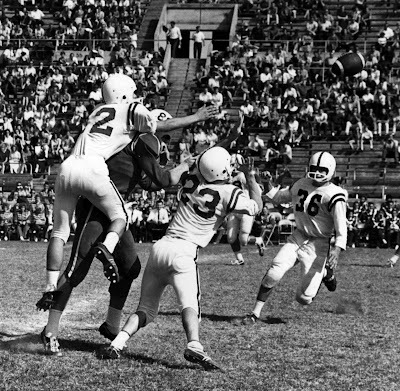
"Max had better hands than mine so he got a lot more opportunities to carry the ball than I did.  However, one of the coaches gave me this picture shortly after our game with North Side and it looks like I was a practitioner of lowering my head into a defender.  Coach Graves often yelled, “Crunch their sternum,” and Coach Willingham always bellowed, “Where their head goes, their body has to follow.’  So, to the best of our ability, we crunched their sternums and moved their heads out of the way.


 "The second picture came to me by some means that I’ve forgotten, but it sure shows the traffic we had to contend with.  By the time we got to this age, our moves were pretty instinctive which meant we used our heads.  I suspect the newly proposed rule has come by way of some T-ball coach or maybe a Soccer Mom.  My own opinion is: Leave the game alone.


"The next picture is one that I always viewed with mixed emotions.  It shows Max and I at the end of the season, in peak shape, and looking forward to taking on the Dallas champions.  But the headline kind of bugged me.  It reads as if Coach Mitcham is having trouble getting his thoughts through our skulls, but it really referred to the next being his 100th game as a coach.  


"And one more from my personal collection.  It’s a wonderful publicity photo taken, I think, just after the great Paschal win and we were flying high.  That’s a pile of fine kids and standing behind them, a great coach--my favorite."

Two of these guys were Juniors, Class of 1964.  They were Ray Avery and Steve Rose, both of whom were All-District players the next year and both of them, outstanding kids.  We had a superb line.


Adios

Saturday, March 16, 2013

Handley High School Scrapbook

1925
This post will illustrate some of the images of the Handley High School campus over the years it was in service before EHHS.  They come from a fine collection of early Handley yearbooks gathered together for viewing and download on the fine 1959 Handley reunion site kept by David McConnell. 

1944
A few of my EHHS classmates may have had parents that also attended this school. Let me know who they were. Dona B's Daddy graduated from here in 1937, went off to WWII, then came back to teach some of us at Meadowbrook Elementary. 

Miss O'Dell was a fixture in this building for many years before we encountered her at EH. 

Ted Harris' dad was a long serving teacher and administrator here, too. 40% of our first coaches came from here, and some of our most influential teachers also hailed from Handley.

Thursday, March 14, 2013

Handley High School – Class of 1955


I don’t know any of these people, they are 8-years older than the EHHS Class of 1963.  However, after running across some remarkable Handley Elementary class pictures of the future HHS Class of 1955, there appeared to be a convenient way to illustrate Handley’s scope in our years at EHHS.  


As a relative newcomer in 8th grade to the Meadowbrook crowd, Handley, to me, was just a school name on a ribbon that we had to go out and beat in a football game.  Unlike some of my Meadowbrook classmates, I had had no experience with the Handley kids while playing summer Little League, or at church.  When I first saw the Handley contingent at EHHS, fall 1960, they were just another group of strangers.  I never had any idea how many of them there were…all the way through EH.


All I knew was that there were some new good-looking girls to add to the pool that came in with us from Meadowbrook and some big new boys to compete with for a spot on the football team. 


Thanks to the amazing work of David, a HHS’59, who has posted full scans of Handley yearbooks going back into the 1930s, it’s relatively easy to visually illustrate Handley.  This 1955 class consisted of 75 grads which was at the upper end of a usual range of 50-75.  By comparison, George Bradford reported that his EHHS Class of 1960 consisted of 60 Handley cohorts who came over to the new school to become about half of the first EH graduates. 


The elementary class pictures of this same group of kids may illustrate something else that I’ve been told by others; that being, Handley was generally considered by the Meadowbrook parents as being poorer and that it offered a lower quality education than did Meadowbrook.  Note in a couple of the class pictures that some of the boys are barefoot (grades 3 & 5).

 
That the Handley neighborhoods of the time were more rural than Meadowbrook was a fact.  Also, that the houses tended to be smaller is a fact.  However, insofar as I can determine from observation and conversations with others, the education the Handley kids received might actually have been somewhat better than we got at Meadowbrook…it was at least on a par.

>>Now, if one of you Handley Dorks who graduated as a '63 Highlander will get off your duff and scan a series of Handley Elementary class pictures of your classmates, I can do another posting like this one, only with familiar faces !  (A '62 or '64 would be fine, too!)<<

How the Handley kids fared at EHHS will be included in an upcoming series of the EHHS social order. 


Adios - By the way...those barefoot boys look exactly like I looked from the last day of school each year until they dragged me back to start again the next fall.  I think I have a very faint recollection of the teachers permitting barefoot boys on the last day of school at least a few of those years.  So, maybe it was some kind of tradition in certain circles.


Tuesday, March 12, 2013

Quintessential Texas - Spring Bluebonnets


One of the neat things about the net and Facebook is that some of my friends have been putting up some great bluebonnet photos recently.  What's better than a Longhorn in a field of bluebonnets?


...or a chicken...but, be careful...


 ...one guy added...watch out for the fire ants, too.


Oh yes, this is a very good day !

What now?  Lost 'em or can't find 'em ?
Adios